| Author |
 Topic Topic  |
|
audioguru
Nobel Prize Winner

Canada
4218 Posts |
 Posted - Nov 23 2008 : 11:08:03 AM Posted - Nov 23 2008 : 11:08:03 AM


|
The inverter project DOES NOT WORK!
Read all about it in this thread. |
 |
|
|
pebe
Nobel Prize Winner
United Kingdom
1078 Posts |
Posted - Nov 23 2008 : 3:37:11 PM
|
I'm surprised Aaron has not removed this faulty circuit from the site.
Quite apart from the damaged components people have had to put up with, there's a potential personal accident from a blown up electroytic just waiting to happen! |
|
|
|
raaahuul
New Member
1 Posts |
Posted - Nov 30 2008 : 1:06:48 PM
|
| i want backup of inverter for 4 hours with 2 CFL(20 watt)& single fan what will b the battery's current rating? |
|
|
|
audioguru
Nobel Prize Winner
Canada
4218 Posts |
Posted - Nov 30 2008 : 2:58:48 PM
|
quote:
Originally posted by raaahuul
i want backup of inverter for 4 hours with 2 CFL(20 watt)& single fan what will b the battery's current rating?
The current rating of the battery is not its capacity. Its capacity is how long it can deliver a certain current and is measured in mAh (milli-amp hours).
Calculate the total output power required then add about 20% for running an inverter. then calculate how much current from the battery and compare it to the mAh of batteries.
Instead of wasting power with an inverter, use 12V CFL bulbs and a 12V fan.
|
|
|
|
mansoorkkl
Apprentece

India
5 Posts |
Posted - Mar 12 2009 : 12:58:02 PM
|
| 4000w inverter plz |
|
|
|
Amaar
Apprentece
Pakistan
6 Posts |
Posted - Apr 05 2009 : 05:44:13 AM

|
[quote]Originally posted by audioguru
SupraGuy,
Sorry to hear your experience with this bad circuit.
For your applications, why not keep it supra-simple:
1) A CD4047 oscillator/divider/opposing-outputs chip as the oscillator-driver. It needs only 1 resistor and 1 capacitor. Its outputs are perfectly symmetrical, and are direct and inverting.
2) A pair of power MOSFETS with built-in zener protection diodes as the output transistors.
3) A regular 50Hz or 60Hz center-tapped transformer, or a smaller high-frequency one.
300W would be easy.
I would post a circuit but I don't need another power supply. Why don't you?
Hi sir, I tried to build a simple inverter using CD4047BE IC and two IRFZ44 MOSFETs but its not working on a proto board and the problem is that CD4047 is giving out continuous voltage
rather than pulses. I used DC link to provide 12V to the circuit. |
|
|
|
audioguru
Nobel Prize Winner
Canada
4218 Posts |
Posted - Apr 05 2009 : 09:40:41 AM
|
Hi Amaar,
Post your schematic so we can see what is wrong with it. |
|
|
|
sympsyd
Apprentece
5 Posts |
Posted - Apr 10 2009 : 10:10:47 PM
|
| till now i have been using inverter circuit built up of thyristors. but upon seeing this particular inverter circuit, i found it very much interesting. so, can anyone here explain me the working mechanism of this particular invertor? i would be very much grateful. |
|
|
|
audioguru
Nobel Prize Winner
Canada
4218 Posts |
Posted - Apr 11 2009 : 10:32:46 AM
|
This inverter circuit does not work.
Its capacitors have backwards polarity so they blow up.
The transistors have avalanche breakdown of their emitter-base junctions so they waste most of the current by blowing up the capacitors even if their polarity is corrected.
The transistors do not have enough base current for an inverter.
Look up Transistor Multivibrator Circuit in Google. The Wikipedia article mentions protection diodes to avoid emitter-base breakdown of the transistors.
Some articles have the polarity of the capacitors backwards. |
|
|
|
mrgraph003@yahoo.com
New Member
USA
1 Posts |
Posted - Apr 22 2009 : 5:30:23 PM
|
quote:
Originally posted by audioguru
Changing T1, Q1 and Q2 in this simple circuit has nothing to do with increasing its output power because the circuit doesn't work. Its output power is only about 25W with a low output voltage, not anywhere near 300W.
The polarity of the capacitors are backwards and the transistors have avalanche breakdown. The transistors don't have enough base current.
You want the math? It is difficult to determine how much power is wasted by heating the backwards capacitors with the very high current pulses caused by the transistors avalanching.
The transistors have base resistors that are 180 ohms so the base current is only (13.2V - 1.0V)/180= 68mA. The typical current gain is 50 so the collector current is 3.4A. The output power is 13.2V x 3.4A= 44.9W minus the wasted power. The transistors saturate poorly unless the base current is much higher. If your transistors have minimum gain then the output power and voltage will be much lower.
For an output power of 300W then the power from the battery must be about 360W. Then the current in each transistor must be 360W/13.2V= 27.3A. But the absolute max allowed current for the 2N3055 transistors is 15A and they work poorly at 10A to 15A. I don't know of a power transistor that has a good current gain with a current of 27.3A.
Kasamiko's inverter is 500W and uses 8 2N3055 output transistors, 2 2N3055 driver transistors plus pre-driver transistors. It has a separate oscillator so its transistors do not have avalanche breakdown and its capacitors use low power.
5000W is rediculous from a 12V battery. The current would be 500A!
|
|
|
|
dimestone
Apprentece
USA
6 Posts |
Posted - Apr 24 2009 : 9:35:46 PM


|
I got familiar with this forum yesterday, I read the 52 pages in this forum and followed many of the links to their destination. It took a while to read it all, hours. Feel like I've known you all for years!
My first interest lay there with Aaron's schematic, this is how I found this place.
I also saw that Aaron had made some comment about his inverter, but after going back through the forum later I could not find it. Anyway that post had to do with his schematic being properly configured and how he had taken 1000 volts.
I added this myself to discover that he did not take 1000.
68uF
25v
68uF
25v
10ohm
5watt
10ohm
5watt
180ohm
1watt
180ohm
1watt
154 silicon diode, that's why they mark them like this, no volts, no nothing, just nothing but a number
154 silicon diode
60v 2N3055 transistor
+ 60v 2N3055 transistor
-------------------------------------
= 1006
-24v for the transformer. You must deduct for transformers, these are all volts, no impedance.Its O.K. if you don't deduct it for your circuit but be sure you remember yourself what it is going to do to the final.
I've edited this post several times, but want to recant this -24. I don't really think a transformer this small is needing 24 volts to power up since there isn't anything impeding it, so I'll go -2v on this, so.
= 1006
-2
---------
= 1004 volts that Aaron took, and with his caps rated at 60v this is a meteor shower.
---------------------old post below---------------------------------
___________
= 982 I get 982, This could be good reason why it doesn't work. Even if it had been 1006 this is not 1000 and those 6 volts could be the difference. In reality 1 volt over just a few seconds can be like driving a locomotive through your living room and over the top of your circuit, leaving it totally fried.
-------------------------old post above-----------------------------
O.K. thanks for the legend of Aaron's schematic. I really had a great time reading through all of this.
I am going to begin drawing my own inverter circuit in a day or so when my new volt meter arrives. Maybe I too can get some help from audioguru. |
Edited by - dimestone on Apr 26 2009 01:16:17 AM |
|
|
|
dimestone
Apprentece
USA
6 Posts |
Posted - Apr 24 2009 : 10:09:30 PM
|
If ever you find yourself making to many volts at or near MOSFETS you can make the circuits wider and you will correspondingly lower the resistance and lower the voltage. Fatter circuits will do this. You may also raise the voltage and the resistance by making the circuits narrower. If the circuit is designed perfectly to begin with, these things won't matter, but doing so takes some math and more time to figure the correct corresponding size. See this link to read all about it, http://en.wikipedia.org/wiki/MOSFET . The equations to do this are within this link, I think we would all need to study that a bit, but mainly using components in the sizes that we can work with ourselves, just remember you can add a little circuit wire in between the MOSFETS or take a little out to get it just right.
For the real deal that we are all trying to get at Absolutely positively go here now and read this , you will need to copy and past this entire link into your browser because this message board cannot inlcude the entire link http://en.wikipedia.org/wiki/Inverter_(electrical) |
Edited by - dimestone on Apr 25 2009 06:16:22 AM |
|
|
|
dimestone
Apprentece
USA
6 Posts |
Posted - Apr 25 2009 : 12:42:24 AM
|
Hope you don't mind Aaron, I just want to see if this is a fix for this.
Do be considering an option like this http://www.crutchfield.com/p_220ADC120/Audiovox-ADC120.html?search=power+inverter if it is going to cost you less, this one is $19.99 US. I can tell you right off that the 4 capacitors that are selected for you to use already puts the total at $19. Use an alteranative that you think is best if it comes down to that for you.
Try this revision of Aaron's schematic instead, with better results I hope. I am not going to make this, not anytime soon, but if some of you have most of the stuff all we are talking about is 4 more capacitors and 4 more resistors. All in all, this circuit has 2 more capacitors and 2 more resistors thrown into the circuit, should be a breeze for those that already have the stuff. The new parts list is below the image of this new circuit.
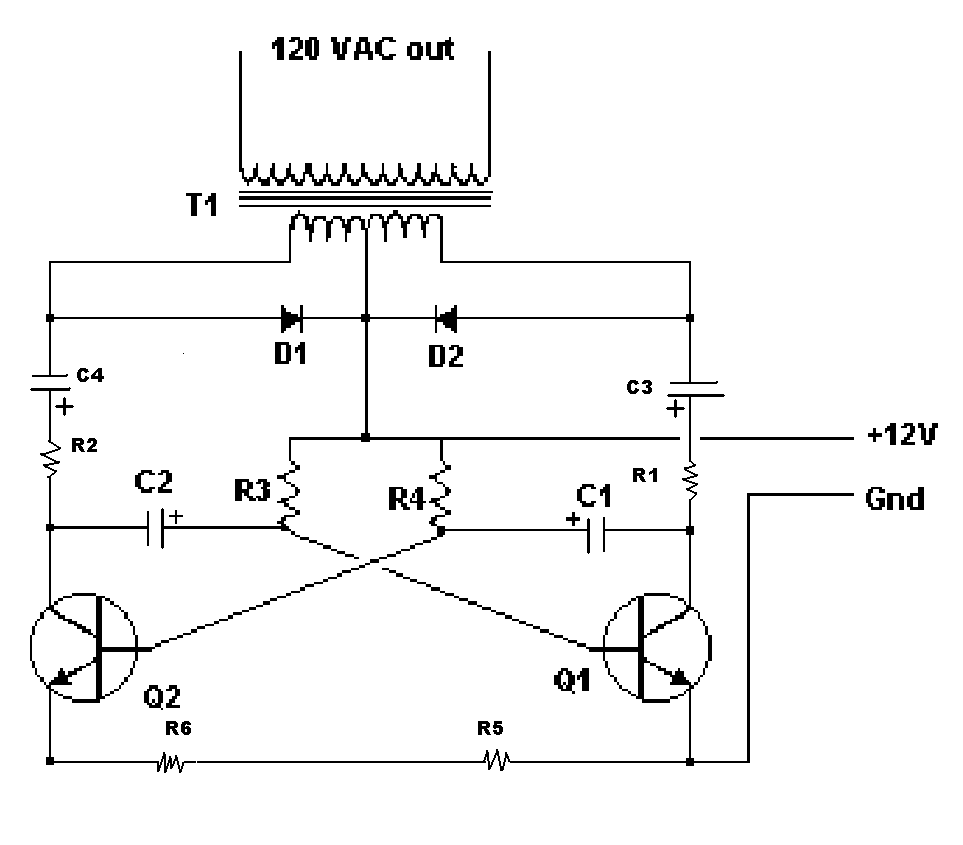
Download Attachment:  inverter3.GIF inverter3.GIF
12.42 KB
Part Total Qty. Description Substitutions
C1, C2 , C3 , C4 4 33 uf, 16 V Tantalum Capacitor , the other capacitor selection was 68uf , 25v , but we shouldn't use capacitors rated higher than the circuit we are making. Here is a manufacturers part number for the new capacitors Available Alternate Packaging T520V336M016ATE045. http://www.digi-key.com this is the digi-key part number 399-4738-2-ND if you want a 1000 of them, but this is the one you can buy individually 399-4738-1-ND.
R1, R2 2 10 Ohm, 5 Watt Resistor
R3, R4 2 150 Ohm, .5 Watt Resistor Available at http://www.radioshack.com Catalog #: 271-1109 . Note these are 1/2 watt rated
R5, R6 2 22 Ohm, .5 Watt Resistor Available at http://www.radioshack.com Catalog #: 271-1103. Note these are 1/2 watt rated
D1, D2 2 HEP 154 Silicon Diode
Q1, Q2 2 2N3055 NPN Transistor (see "Notes")
T1 1 24V, Center Tapped Transformer (see "Notes") I don't know try it without the transformer and see what happens
MISC 1 Wire, Case, Receptical (For Output)
Thank you Aaron and all for all the inspirations to do this, I hope it works! Don't forget to tell me what you think?
|
Edited by - dimestone on Apr 26 2009 3:10:46 PM |
|
|
|
pebe
Nobel Prize Winner
United Kingdom
1078 Posts |
Posted - Apr 25 2009 : 05:14:34 AM
|
That still won't work.
The original circuit is crap and Aaaron should have withdrawn it ages ago. Timkering with it won't help. |
|
|
|
dimestone
Apprentece
USA
6 Posts |
Posted - Apr 25 2009 : 06:28:38 AM
|
quote:
Originally posted by pebe
That still won't work.
The original circuit is crap and Aaaron should have withdrawn it ages ago. Timkering with it won't help.
Care to explain why you won't work and just came across an extra $25. When in ancient rome I can let you starve to death, but you don't work so you're in the throst. This is a working circuit, post your youtube video of it doing its job well, or otherwise figure on 5 more years of you never getting with it. Don't Timker with anything just do it. Anyone else here that wants to make oppositions to something should express themselves with actions of kind heart. :b hehe |
|
|
|
Topic |
|



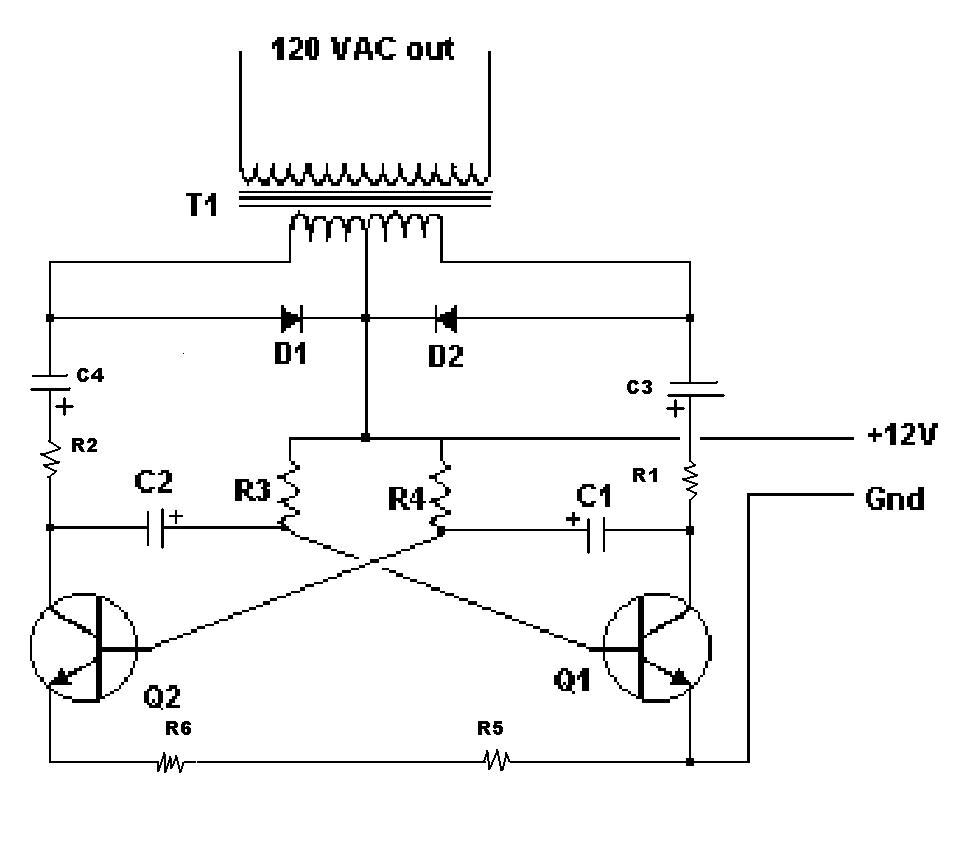
 12/120V inverter again

 inverter3.GIF