| Author |
 Topic Topic  |
|
|
n/a
DELETED (Inactive)
3 Posts |
 Posted - Sep 29 2003 : 6:00:20 PM Posted - Sep 29 2003 : 6:00:20 PM


|
could you explain this circuit. Could you also explain what a solid state relay is and which one is needed for this circuit.
|
|
|
Nerf Smurf
Mad Scientist

USA
390 Posts |
Posted - Sep 30 2003 : 01:38:47 AM


|
You can use a regular relay instead of a solid state relay, but the arcing accross the contacts may destroy it pretty quickly. Explain? http://www.aaroncake.net/electronics/schem.htm Theres a guide so you can read the schematic
Edward, A. Williams Jr.
Have a Problen with that? |
 |
|
|
Aaron Cake
Administrator

Canada
6718 Posts |
Posted - Sep 30 2003 : 09:22:20 AM

|
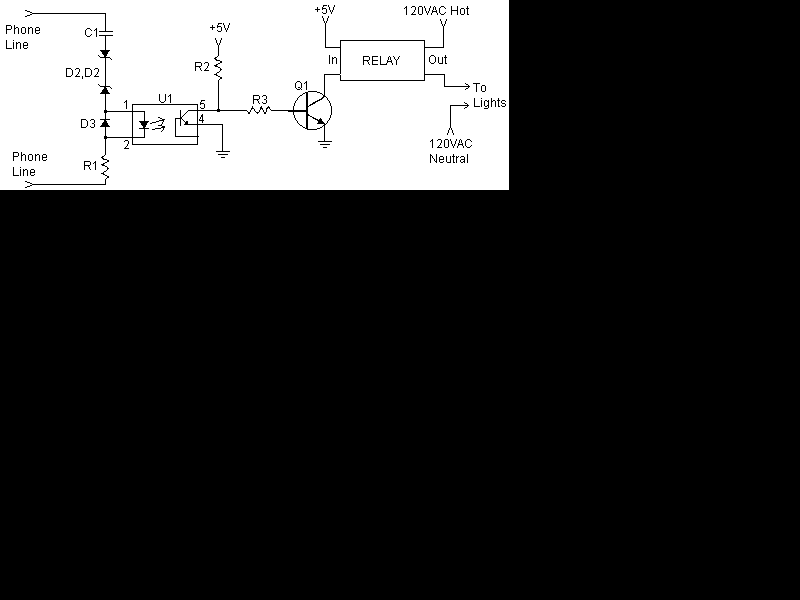
C1 filters DC from the phone line, so the circuit only sees an AC signal. D1 and D2 are 20V zener diodes. They break down and conduct when the phon line voltage is greater then 20V (the diodes are in series), such as when it is ringing (the ring signal is a 60Hz signal greater then 60V). D3 rectifies that AC ring signal to a DC voltage to power the LED in the opto-isolator, which is current limited by R1. An opto-isolator is necessary to protect the rest of the circuit from the phone line, and the line from the rest of the circuit.
The transistor in the opto-isolator is turned on when the LED is powered, and forms a standard emittor follower switch with R2. R2 provides the forward voltage needed by the transistor to switch. When it switches, it also activates Q1 via R3 (a current limit resistor). Q1 conducts, and activates the solid state relay.
A solid state unit is used because a mechanical unit would quickly wear it's contacts out due to the rapid switching.
|
|
|
|
Answer
Apprentece

Canada
7 Posts |
Posted - May 23 2004 : 3:00:28 PM
|
So this means I should have 0v at the relay when the phone is not ringing and 5v when it rings? So putting a LED instead to see how the circuits acts should work? I tried it and the led is ON when there is no ring and pulses off when the phone rings... I'm using a 4N26 instead of a 4N27, should work the same?
|
|
|
|
Answer
Apprentece
Canada
7 Posts |
Posted - May 25 2004 : 5:03:28 PM
|
Anyone???
|
|
|
|
Aaron Cake
Administrator
Canada
6718 Posts |
Posted - May 26 2004 : 09:12:31 AM
|
Where are you measuring for 5V?
|
|
|
|
Answer
Apprentece
Canada
7 Posts |
Posted - May 26 2004 : 10:37:23 AM
|
between the collector of Q1 and +5v, where the relay should be connected...
I also don't want the light to flash but to be light up during the duration of the ring... I want to drive a 5v relay to be able to make a car alarm siren to sound when the phone rings
Edited by - answer on May 26 2004 10:46:57 AM |
|
|
|
n/a
DELETED (Inactive)
4 Posts |
Posted - May 30 2004 : 01:01:43 AM
|
In this circuit the output always active when no ringing signal, because the Q1 opened via R2 and R3. U1 optocoupler periodically close Q1 when ringing signal present = flashing output.
Basically i don't understand why need the optocoupler, transistor and additonal 5V supply, because the solid state relay input also optocoupler.
Answer, You need a capacitor after opto, and use PNP transistor.
|
|
|
|
Answer
Apprentece
Canada
7 Posts |
Posted - Jun 06 2004 : 4:23:13 PM
|
Still having problems to get the light to light up without flashing... I tried to put a capacitor in parallel and in series with the resistor going to the base of the transistor and it did helped a little, but there's still a lot of flashing. I tried a 1000uF 35V capacitor...
Anybody can help? It's been a while since I designed anything so i'm rusted...
|
|
|
|
Answer
Apprentece
Canada
7 Posts |
Posted - Jun 08 2004 : 9:22:44 PM
|
Help would be greatly appreciated here! I have a friend waiting after me!
Thanks!
|
|
|
| |
Topic |
|



 Ringing phone light flasher
