| Foolshatch |
FM Telephone Bug |
Thursday, May 10, 2012 9:23:19 PM |
| Nice. Actually its always good to have some elementary mistakes in schematic. So it will dump these fools around here who want to make all fast / grap/rip for their university courses and have no patience. Its very hilarious about led and switch and gurus can laugh later when the fools around here comment what happened with them or cant make it work... :D :D |
| Spork |
FM Telephone Bug |
Sunday, August 15, 2010 2:14:51 PM |
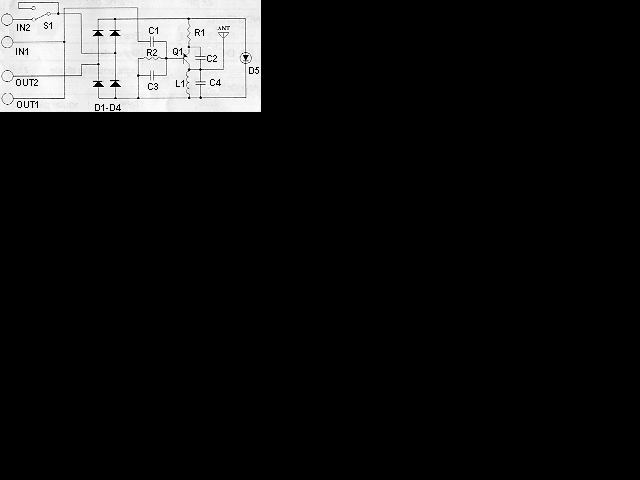
| For those asking why there's two inputs and two outputs, in the states, when you rip apart a phone line, you'll notice 4 wires. Two of these wires are generally not used. Once you splice the wire, instead of having one main telephone wire, you'll have two. The telephone wire that goes to the source (outside), is IN. The one that goes to the telephone, is OUT. You take the two wires inside of the IN main telephone wire and put it in IN1 and IN2 respectively. Then you do the same for the OUT1 and OUT2 but with the main line that goes to the telephone. |
| anonymous |
FM Telephone Bug |
Tuesday, July 27, 2010 11:24:57 AM |
| could someone please suggest an equivalent diode, mabye one that is more common, to use? i cant seem to find the "1SS119 Silicon Diode". also a link to a site where they sell this diode or a similar one would be great. |
| WICKED |
FM Telephone Bug |
Wednesday, June 16, 2010 11:30:56 PM |
| is the oscillator Q1, C2, C4, L1, R2, R1, and C1 |
| Riaz |
FM Telephone Bug |
Wednesday, June 16, 2010 12:45:33 AM |
| I made this circuit as a project for telecommunications class. It works well and is fairly easy to assemble. yes, capacitors can be a little different than shown above (using a 10pf cap instead of a 13pf, for example). Two notes: Switch is useless in this schematic, as it would simply separate the phone line from the rest, so you can just eliminate it. You can also get rid of the LED (there is absolutely no point in having a bug with a light). For the connections, here is a image of how to connect: http://img689.imageshack.us/img689/2186/bugconnect.png . This circuit does not care which side of the connection is in and which is out. If built compactly can easily fit inside a small phone box. Good luck, and have fun! btw, why silicon diodes? germanium work just as well as far as i can see! |
| 9A3HP |
FM Telephone Bug |
Tuesday, May 25, 2010 6:51:28 AM |
| http://www.postimage.org/image.php?v=PqFJ_Or
switch must be connected between IN2 and OUT2 when switch is close, bug is off, if switch open bug is on.
470 and 471 pF same work well , any 1N4xxx will be same ,
how connected IN1 and IN2 to phone line, OUT1 and OUT2 to telephone device, simple ? |
| anonymous |
FM Telephone Bug |
Saturday, March 20, 2010 6:38:00 PM |
| I can't seem to find a 471pF capacitor, but i suppose i can use a 470 pF? |
| anonymous |
FM Telephone Bug |
Saturday, February 06, 2010 5:21:45 AM |
| how do we connect circuit to the phone line because we have two inputs and two outputs? |
| 9A3HP |
FM Telephone Bug |
Thursday, October 22, 2009 1:36:03 PM |
| I see previous this schematic diagram and same error occurs in any possible web sites , the switch is wrong placed in schema.
Switch must cutoff bug from telephone line and close contacts that
IN2 and OUT2 short between. This only have logic.
No hard feeling.
|
| siva |
FM Telephone Bug |
Thursday, September 03, 2009 1:15:37 PM |
| we are highly interested in doing this as our semester project. But we are facing difficulties understanding this circuit as it has 2 inputs and 2 outputs. Kindly send us details in this regard and if u could send us report we will be highly thankful.... |