Remote Telephone Ringer


Author Views Views Today Rank Comments
19,575 3 1

This remote telephone bell ringer allows you to use a large (and loud) external bell in place or in addition to the built in (and rather wussy) ringer in most modern telephones. This is ideal for large outdoor areas, noisy shops or those hard of hearing. Most any large bell can be used as the circuit can be easily adjusted for various supply voltages.

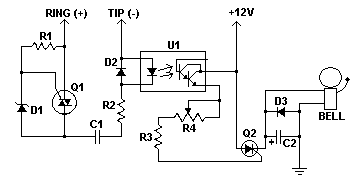
Schematic

Schematic for remote telephone ringer

Parts

Part
Total Qty.
Description
Substitutions
C110.47 300V Capacitor
C2147uF 25V Electrolytic Capacitor
R111K 1/4W Resistor
R2110K 1/4W Resistor
R311K Pot
R412K 1/4W Resistor
Q116A, 200V TRIAC
Q216A, 200V SCR (106, Etc.)
D111N4774 Zener Diode
D2, D321N4007 Rectifier Diode
U114N33 Opto Isolator
BELL1Large Bell (Fire Bell, School Bell, Etc.)
MISC1Board, Wire, Socket For U1, Case

Notes

  1. Virtually any TRIAC and SCR will work for Q1 and Q2 as long as the voltage rating is high enough. Q2 needs enough current capacity to handle the full load of the bell.
  2. To adjust R3, call the phone line on which the ringer is installed and adjust the pot until the bell begins to sound consistently.
  3. Make sure to check with local authorities before you connect a homemade device to your phone lines. Some areas mandate that only approved devices can be connected to the loop. This circuit provides an opto-isolator to prevent cosstalk between the phone line and power supply as well as to avoid ground loops.

Related Circuits

Ringing Phone Light Flasher, Phone Busy Indicator, FM Telephone Bug, Cut Phone Line Detector, Simple Phone Tap, Telephone Hold Button, Telephone Recorder, Remote Telephone Ringer

Comments

asutosh pradhan
Remote Telephone Ringer
Tuesday, July 29, 2008 11:39:47 AM
its a very wonderful circuit i really thanks to the person for making such cirfcuit whch will b very useful
The last 10 comments are currently shown. Show All Comments.

If you would like to leave a comment, you can do so using the form below. Comments can be things like suggestions, successes or failures, improvements, similar circuits, error reports, an answer to a previous commenter's question, or anything in between. However if you would like to ask a question it is suggested that you use the forum instead. The forum provides a more robust environment for discussion.

Important: If you post a technical question here, there is no guarantee it will be answered. All technical questions should be posted to the forum. The owner of this site generally does not answer questions in comments.

All comments are subject to approval before they are displayed here, so your comment will not appear immediately. This is done mainly to prevent spam and other abuse. If you wish to remain anonymous, simply enter "anonymous" for your name and/or email.

Name:
Email:
Subject:
Comments:
Anti Spam Code:
Please enter the exact text shown in the image above into the box below.
Browser cookies must be enabled to comment on circuits.

Privacy Policy

Back To Circuits Page | Mail Me | Search