Car Battery Charger


Home > Circuits > Power Supply > Car Battery Charger
Author Views Views Today Rank Comments
423,094 182 146
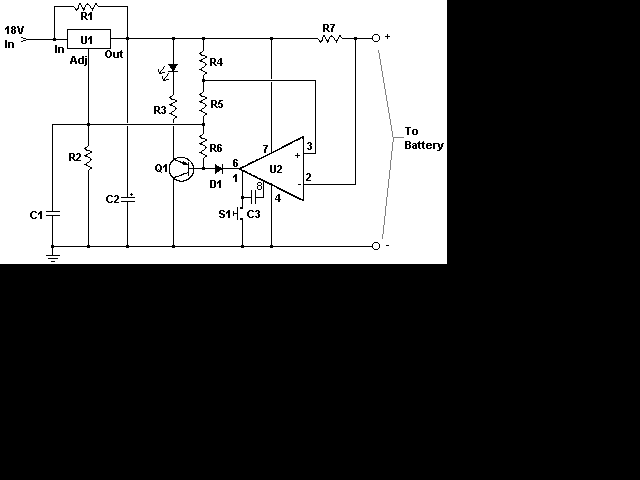
This charger will quickly and easily charge most any lead acid battery. The charger delivers full current until the current drawn by the battery falls to 150 mA. At this time, a lower voltage is applied to finish off and keep from over charging. When the battery is fully charged, the circuit switches off and lights a LED, telling you that the cycle has finished.

Schematic

This is the schematic of the Car Battery Charger

Parts

Part
Total Qty.
Description
Substitutions
R11500 Ohm 1/4 W Resistor
R213K 1/4 W Resistor
R311K 1/4 W Resistor
R4115 Ohm 1/4 W Resistor
R51230 Ohm 1/4 W Resistor
R6115K 1/4 W Resistor
R710.2 Ohm 10 W Resistor
C110.1uF 25V Ceramic Capacitor
C211uF 25V Electrolytic Capacitor
C311000pF 25V Ceramic Capacitor
D111N457 Diode
Q112N2905 PNP Transistor
U11LM350 Regulator
U21LM301A Op Amp
S11Normally Open Push Button Switch
MISC1Wire, Board, Heatsink For U1, Case, Binding Posts or Alligator Clips For Output

Notes

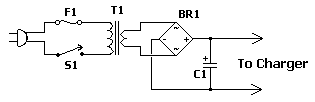
  1. The circuit was meant to be powered by a power supply, which is why there is no transformer, rectifier, or filter capacitors on the schematic. There is no reason why you cannot add these.
  2. A heatsink will be needed for U1.
  3. To use the circuit, hook it up to a power supply/plug it in. Then, connect the battery to be charged to the output terminals. All you have to do now is push S1 (the "Start" switch), and wait for the circuit to finish.
  4. If you want to use the charger without having to provide an external power supply, use the following circuit.

    This is the schematic of the Car Battery Charger Power Supply

    Part
    Total Qty.
    Description
    Substitutions
    C116800uF 25V Electrolytic Capcitor
    T113A 15V Transformer
    BR115A 50V Bridge Rectifier10A 50V Bridge Rectifier
    S115A SPST Switch
    F114A 250V Fuse

  5. The first time you use the circuit, you should check up on it every once and a while to make sure that it is working properly and the battery is not being over charged.

Related Circuits

6V to 12V Converter, Portable CD Player Adapter For Car, Car Battery Charger, Automatic 12V Lead Acid Battery Charger, Solid State Tesla Coil/High Voltage Generator, 12VDC To 120VAC Inverter, LASER Power Supply, Power Supply, High Current Power Supply, Dual Polarity Power Supply, High Voltage High Current Power Supply, Transformerless Power Supply, Fixed Voltage Power Supply, Voltage Inverter, Voltage Inverter II, Automatic Load Sensing Power Switch, 12V To 24V DC-DC Converter, Solid State Tesla Coil

Comments

Add A Comment

georgi
Car Battery Charger
Wednesday, January 20, 2010 2:24:24 PM
R1 1/4W ??? Out 3A R7 10W ???
baraa
Car Battery Charger
Friday, January 08, 2010 6:47:26 AM
what is the current output rating of this charger? cuz all of these equipment have current rating of milli amps i am an electrical engineering student but i haven't dealth with car batteries much, are all of them 12V (i mean to ask about the output voltage rating) thx a lot
brockster
Car Battery Charger
Monday, December 07, 2009 11:17:37 PM
@Woody: Oops, my error. The LM350 limits the maximum charge rate to 3 amps, not 2 amps. Running at 3 amps, you will need to heat sink the LM350 fairly well, even if the input voltage is only 18 volts or so.
brockster
Car Battery Charger
Monday, December 07, 2009 11:04:58 PM
Thanks for posting this useful circuit! @Randy: Yes, you can substitute 510 ohms for the 500 ohm resistor. Better yet, just use a diode, such as a 1N4006. The cathode side should point toward the "in" terminal in the schematic. @zizo: Yes, you can substitute any similar "small signal" type diode as long as it can handle 200 ma of current and 70 volts of repetitive reverse voltage. The popular 1N4148 ought to work. @anonymous: Use the momentary switch as indicated. This is just a "force to start the charge cycle" button. The cricuit may start charging even without pressing this button. You can find momentary switches at Radio Shack or any electronics parts shop. @Woody: The maximum charge rate is limited to 2 amps. This is set internally by the LM350 voltage regulator. @Martins and Umar: To get more output current you would need to add a "current pass" transistor to the circuit or use several LM350's in parallel. You would be better off not using this circuit and simply using another circuit rated at 10A. See the application circuits in the LM350 datasheet (link below) for ideas. @All: This circuit is from the LM350 datasheet. See this circuit, and other charger ideas, in the datasheet at http://cache.national.com/ds/LM/LM350.pdf
Tim
Car Battery Charger
Sunday, December 06, 2009 4:41:52 PM
I'm a mechanical engineering student working on a senior design project. All the electrical stuff is a little out of my element. I'm needing a circuit to charge a 12v car battery from a DC generator. Would this circuit be what i'm looking for?
Randy
Car Battery Charger
Friday, November 06, 2009 6:20:15 PM
can you Substitute R1 500ohm with a 510? and R5 230 with a 220 i am unable to find them. thank you
anonymous
Car Battery Charger
Saturday, September 12, 2009 9:54:40 AM
can i replace this switch with a non momentary switch
zizo
Car Battery Charger
Thursday, September 03, 2009 8:42:33 AM
I could'nt find D1 1N457 Diode. What can use else instead of it ??? is there any substitution ?? thank you.
woody
Car Battery Charger
Thursday, July 16, 2009 9:09:10 PM
I like your circuit but the info does not state the maximum current charge rate. please state same. thanks.
umar
Car Battery Charger
Saturday, July 11, 2009 3:12:11 AM
Thank's for your circuit. I need a battery charger that can charge 12 V 10 A. what can I do for that problem, can You send me circuit for that? Thank's....
The last 10 comments are currently shown. Show All Comments. Add A Comment

Back To Circuits Page | Mail Me | Search