| Author | Views | Views Today | Rank | Comments |
| 140,419 | 12 | ![]() |
53 |
|
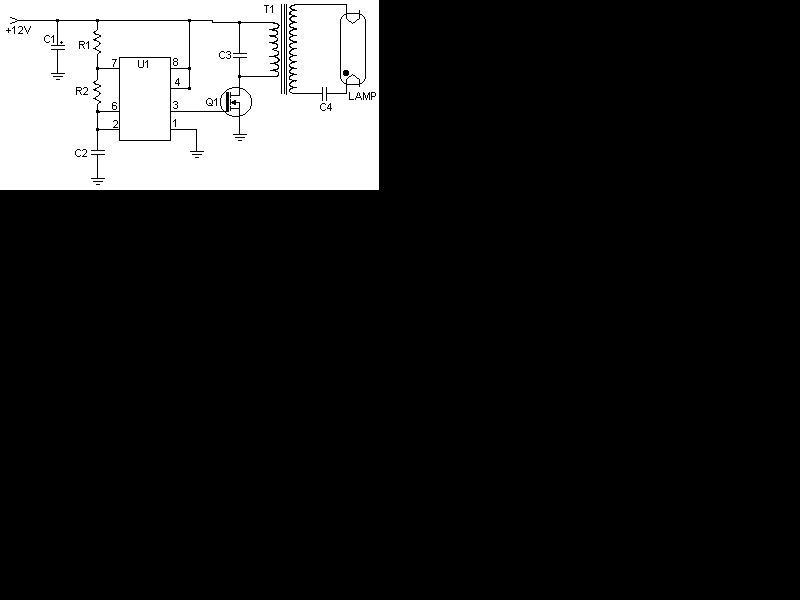
A number of people have been unable to find the transformer needed for the Black Light project, so I looked around to see if I could find a fluorescent lamp driver that does not require any special components. I finally found one in Electronics Now. Here it is. It uses a normal 120 to 6V stepdown transformer in reverse to step 12V to about 350V to drive a lamp without the need to warm the filaments. |
Schematic |
Parts |
|
Notes |
Related Circuits |
Comments |
| The transistor did not get hot when I put a transformer on this curcuit with a primary resistance of >3.00§Ù but did with lower resistances. | ||
| Hey, Engineer if you are really smart enough. Why don't you upload your design here so we can all see what you are talking about. | ||
| oh guys...you guys are just so so so stupid. that circuit is all wrong.you will fry the mosfet in secounds if you fuck up something here. ya all know the old trick of using CD4047 with just a RC circuit to set it to oscilate. then use a couple of NPN transistors...preferably Power transistors. this is to buff up the waveform output and proved proper power so that it can hand;e up to 30 amps. i used 2N3055. you could also use 2N2955....just have to flip a few components around....and then you could use a heavy duty transformer..say you have a 240 to 12v 6 amps step down transformer...ya just have to connect the transformer to accept the amplified waveform (very powerfull) to the secoundary of the transformer....in this case we will say the 12 volt side...once powered up...you will get a deadly 240Volts output on the transformer...do it at your own risk..... i also use old car ignition coils to run a 40W Fluro light from just a 5 Volt source for more than 2 hours....and this was from a cell phone batteries...cmon man...you guys wana be electronic geniouses....well grow up guys...learn electronics first...its just so so so damn awesome.... | ||
| I built a modified version of this circuit with great results. I used a 6V 1.2A transformer and a 6W lamp. I omitted C4 and connected one pin at each end of the lamp directly to the transformer. With the two remaining pins at each end of the lamp, I connected a 0.001uF 1KV ceramic capacitor between them. This heats the lamp filaments and permits this larger lamp to ionize plus avoids the blackening at the lamp ends. I changed R1 to 270 ohms to acquire approximately 50% duty cycle and a slightly higher frequency coming out of the 555 Timer IC. At 12V, uses approximately 650mA of current. Ample light output. Works great! | ||
| i think 12vdc is good but in our place i dont know if the components are available | ||
| hey i saw your 12vdc fluorescent lamp driver the design was good but can i change the transformer that you gave in that into 200 mA would lamp driver will still function. i'll wait for your answer | ||
| I note several posters saying they will winding the transformer.... READ THE DESCRIPTION!!! The transformer in this unit is a standard small AC power transformer as found in almost any small appliance. The exact primary/secondary voltages are not critical.... the voltage ratio must produce high enough output voltage to fire the flourescent tube. (Apparently about 300V.) The 555 (Yes, the NE555 is equivalent) is connected to produce a square wave at its output pin 3, which causes the MOSFET to switch on and off. This produces current pulses in the primary of the transformer, which steps up the voltage to produce much higher voltage from the secondary to C4 and the tube. Current through the tube is limited by the capacitive reactance of C4. A bipolar transistor could be made to work, but would require an appropriate value resistor between the 555 pin 3 and the transistor base, as well as a resistor from base to ground. The transistor would need to be selected for the appropriate ratings of collector current, voltage and power dissipation. The circuit should still work with a 1A transformer. If the MOSFET is beefed up, it might drive higher wattage lamps. Running a 40w flourescent would require recalculation of values and current ratings. If you want to build one, you will need to do some research and learn enough electronics to do the design yourself. Asking someone to do the design for you means they would need to do several hours of work, even for an engineer who does it for a living. | ||
| the design was good, but what if I'll use a 1 amp. transformer, whould it still function well? | ||
| somebody can explain the purpose of each components for this circuit???thx for help.. n any idea for making this circuit greater?? | ||
| HOW TO MAKE TRAFO | ||
| The last 10 comments are currently shown. Show All Comments. |
If you would like to leave a comment, you can do so using the form below. Comments can be things like suggestions, successes or failures, improvements, similar circuits, error reports, an answer to a previous commenter's question, or anything in between. However if you would like to ask a question it is suggested that you use the forum instead. The forum provides a more robust environment for discussion.
Important: If you post a technical question here, there is no guarantee it will be answered. All technical questions should be posted to the forum. The owner of this site generally does not answer questions in comments.
All comments are subject to approval before they are displayed here, so your comment will not appear immediately. This is done mainly to prevent spam and other abuse. If you wish to remain anonymous, simply enter "anonymous" for your name and/or email.