| anonymous |
Flash Slave Trigger |
Tuesday, March 14, 2017 8:41:42 PM |
| Just sending greetings in 2017 :) It's nice to see this page is still online. |
| Bert Checa |
Flash Slave Trigger |
Friday, December 16, 2011 10:09:33 AM |
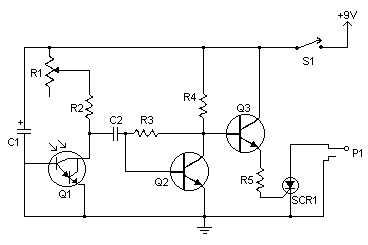
| I think is a missing resistor between base and emiter of Q1. The drawing shown a short between base and emiter of Q1. Will it work this way? Q1 will work as a diode? I dont know, please let me Know. BERT |
| JC |
Flash Slave Trigger |
Monday, September 27, 2010 5:40:16 PM |
| Could this be used with 12 volts? if not what adjustments would be needed for a 12 volt input? |
| H.Johnson |
Flash Slave Trigger |
Saturday, May 16, 2009 3:57:35 PM |
| Xcuse if naive question. I am trying to build a flash for photomicrography based on a luxeon LED (1W or 3W). The idea is to couple the LED to the camera flash with a slave circuit like this one, so that when the camera at one end of the microscope flashes, so does the LED at the other end. A short duration flash is desirable. i do this at the moment with a xenon flash slave unit, and a #8 ND filter which sort of works, but an LED solution would be more elegant. Ideally, one would use the LED for normal illumination, and the same LED in flash mode for photography.
I wonder if you have any comments, of suggestions how I might modify the circuit diagram for this application? I am a hobbyist - not commercial in any way. Thanks and best wishes from Norfolk UK Hugo Johnson |
| anonymous |
Flash Slave Trigger |
Tuesday, March 03, 2009 2:02:12 AM |
| nice circuit..well find and scr here ..a cheap one its very hard but i found one like 12 A/600 volts and cost about one dollar! nice ah!
really i going to buit this ..and of course use a disponsable camera its a very good idea ..i buy one and disademble ..very nice hardwere and very cheap...but be carfully if yuo do that..a big electrolityc capacitor (all flash have one) can give yuo a bad day or can kill yuo..so be very carefully..its all depends on the capacitance of the high voltage cap..typically i dont think that a cap of a disponsable camera can kill yuo bucause they are not to big ..but i dont makke the experiment with nyself so i dont know...but if yuo shot the cap the spark its very big!..so be very carefully when work with this stuff..there mathematicall for this of corse ..yuo can calculete the power, watts of the divice..but i forget that...well its in some book there..i think that this can work whit a simple photo transistor too.of corso the darlintong have and internal amplifier ..more sensitivite and ..more expensive...
so good look with yuo photography experiments... |
| anonymous |
Flash Slave Trigger |
Thursday, November 06, 2008 4:22:56 AM |
| I wonder if R3 would not be more appropriately connected to the ground rather than on the Q2 collector .
Q2 would working in pure switching ... |
| anonymous |
Flash Slave Trigger |
Tuesday, August 26, 2008 5:29:54 PM |
| does not work |
| anonymous |
Flash Slave Trigger |
Tuesday, September 11, 2007 12:26:35 PM |
| R5 - 680 ohm will do just fine with a (SCR1) TIC 106
a good sensitive contruction, ;)
but only the first flash trigger this circuit.
most camaras give two, or use manual mode on the camara.
then you have to think again, but the digital cam give a preview.
this way you can make a other picture.
. |
| Ameya |
Flash Slave Trigger |
Saturday, July 07, 2007 9:38:10 AM |
| How much power supply I shoud give it? |
| anonymous |
Flash Slave Trigger |
Thursday, July 05, 2007 5:33:21 PM |
| R5 please...you owe us that much
(Editor's notes: Search the forum.) |