| oil burner |
Light/Dark Detector |
Wednesday, September 06, 2017 10:53:57 AM |
| Hey please tell me i am used Q2 > LDR without flame: 1Mohm or above, with flame 2 to 5kohm at 10 lux and relay 24vdc normal, operating voltage 24vdc i am like used that circuit but needed component to 24vdc circuit. |
| EMMAn |
Light/Dark Detector |
Monday, January 21, 2013 8:43:36 AM |
| Hey.. i'm just thinking.. how can i use this as a switch for a 220v AC powered Fan.??? should i just put the load in the Relay ???? |
| anonymous |
Light/Dark Detector |
Friday, June 24, 2011 6:50:15 PM |
| Thanks a lot for posting this. but i have one question. How can it be a dark detector since darkness doesn't really exist? (Editor's notes: Sigh...) |
| Chelsea |
Light/Dark Detector |
Sunday, October 31, 2010 4:48:42 PM |
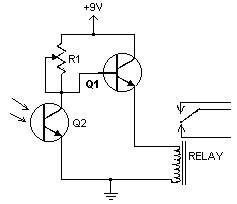
| Do i have to get a knob for R1, will it still work without one? |
| Michael |
Light/Dark Detector |
Saturday, February 13, 2010 10:04:49 PM |
| Thank you for this simple but very effective circuit. It was the answer to my automatic switch machine control problem I was having on a model railroad layout that is still in the design stage. I used a 12 volt relay instead of the 9 volt one listed and it worked the very first time it was powered up. Thanks again |
| fakher |
Light/Dark Detector |
Wednesday, February 10, 2010 8:10:59 AM |
| it is good simple circuit. but it is not as sencitive as it should be.but still it works fine |
| anonymous |
Light/Dark Detector |
Wednesday, December 16, 2009 7:20:31 AM |
| oh! god ..........i jus can't get an idea of the significance of this detector................... |
| anonymous |
Light/Dark Detector |
Friday, October 23, 2009 9:41:04 PM |
| Please tell me in one paragraph what it toke you 4 years to learn.
God people , give the guy a break. It works fine. It don't get any simpler than this. You could buy a book on the subject you know. That's if you can read of course.
Oh,.... 2N3904 worked well for the transistor too. Only had a dozen or two laying around. |
| anonymous |
Light/Dark Detector |
Friday, September 11, 2009 12:50:27 AM |
| is it ok if i dont use 9v relay? I use 5V relay and my supply is 9V.. But it doesnt work. |
| acme fixer |
Light/Dark Detector |
Friday, April 24, 2009 11:02:42 AM |
| NPN Photodetector? One could never tell from the outside whether it's NPN or PNP.
Assume it's a typical relay, say 200 ohm coil. If you connect this circuit to a 9V battery, it will draw three times as much current as a 9V battery usually supplies. The battery will last only a few hours.
The coil should have a 1N4002 rectifier across it, cathode to the positive end. |