Water Detector With Sump/Bilge Pump Controller


Author Views Views Today Rank Comments
10,717 43 9
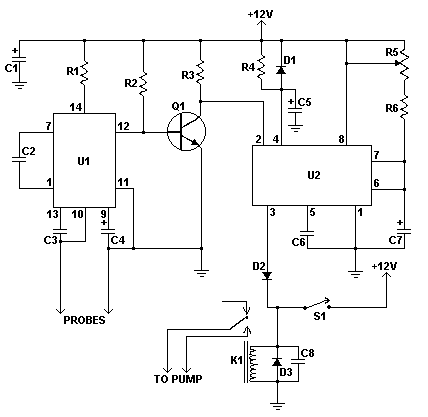
This moisture detector with pump controller is built around the special purpose LM1830 IC. The LM1830 is designed to detect moisture by passing an AC current through a set of probes. An internal comparator compares the resistance of the probes to an internal reference. When the resistance between the probes is low (indicating the presence of water or other conductive liquid) then the IC triggers it's output. An AC signal avoids electroplating and corrosion problems that are common when DC is used. To provide an adjustable delay hysteresis to avoid cycling the pump, a timer based around the 555 is used a range of about 5 seconds to two minutes. In this way the pump will stay active for a set amount of time even if the fluid level is below that of the probes.

Schematic

Scheamtic of the water detector with pump controller

Parts

Part
Total Qty.
Description
Substitutions
R11470 Ohm 1/4 W Resistor
R2, R4110K 1/4 W Resistor
R316.8K 1/4 W Resistor
R511 Meg Linear Taper Pot
R6151K 1/4 W Resistor
C11470uF 35V Electrolytic Capacitor
C210.001uF Ceramic Disc Capacitor
C310.05 uF Ceramic Disc Capacitor
C4120uF 35V Electrolytic Capacitor
C516.8uF 35V Electrolytic Capacitor
C6, C820.01uF Ceramic Disc Capacitor
C71100uF 35V Electrolytic Capacitor
U11LM1830 Fluid Detection IC
U21555 Timer
Q112N5305 NPN Power Transistor
D1, D221N4148 Signal Diode
D311N4002 Rectifier Diode
K11Relay With 12V Coil (See Notes)
S11SPST Switch
PROBES1Stainless Steel Probes (See Notes)
MISC1Case, Knob, Board, Wire, Sockets For U1 and U2

Notes

  1. The probes should be made of stainless steel and mounted in a non-conductive fixture. Stainless steel nails, bolts or welding rod will make ideal probes. Good non-conductive materials are Lexan, plexiglass or plastic. The probes are to be placed at the liquid level at which you wish the pump to turn on.
  2. K1 should be chosen according to the requirements of the pump. If you are running a 12V pump then common automotive relays will work fine. If you are running a mains powered pump then you will need to make sure the contacts are rated accordingly.
  3. S1 provides a manual pump switch.
  4. R5 adjusts the on-time of the pump once moisture has been detected. It is adjustable from approximately 5 seconds to approximately 2 minutes.
  5. The probes should be cleaned periodically to assure reliable operation.

Related Circuits

Air Flow Detector, Wire Loop Alarm, Simple Two Speed Contactor DC Motor Controller , 7 Segment LED Counter, Simple Lie Detector, Low Voltage Alarm, Video Stabilizer/MacroVision Removal, Pulse Width Modulation DC Motor Control, Simple Polarity Tester, Pine Racecar Victory Judge, Rain Detector, Time Delay Relay, Time Delay Relay II, Stepper Motor Controller, Touch Switch, Video Activated Relay, Digital Keypad Combination Lock, AC Motor Speed Controller, Simple Servo Controller, Water Detector With Sump/Bilge Pump Controller

Comments

Anonymous
Water Detector With Sump/Bilge Pump Controller
Sunday, May 04, 2008 5:10:10 AM
Just like chris I need a circuit for refilling a tank. Could you please send me the circuit or instructions on how to modify this one to do it. I know how to make a detector and refill for a single probe. But it wouldn't do much good because it would need a few seconds after the initial low point to get the fluid back up to a suitable level. If anyone knows how could please email me.
anonymous
Water Detector With Sump/Bilge Pump Controller
Tuesday, April 01, 2008 3:08:17 PM
i have to make a working model for water level indicator n controller. so can u plz send me some more details about this circuit.
chris
Water Detector With Sump/Bilge Pump Controller
Monday, March 03, 2008 3:45:45 PM
hi we are doing a water conservatin progect at school and are building a model we need a circuit for filling a tank so a pump is turned on and refilles the tank when water is running low we have a 240vac pump (were in the uk) and your circuit looks extremely practical can you send me any extended details if you have them thanks chris
Billous
Water Detector With Sump/Bilge Pump Controller
Sunday, February 17, 2008 4:38:10 PM
Why do you put a 470 ohm res. at Pin 14 that is +Vcc. The mfgr cites +16V operating voltage and direct connect to Vcc. Where can this be purchased... Mouser and Digikey don't have it in stock.
irshad
Water Detector With Sump/Bilge Pump Controller
Saturday, February 16, 2008 10:42:33 AM
when the u2 ic will get activated and how the relay is switched on , you have given 12v dc via a s1 to the coil of the relay and o/p of u2 is connected via a diode d2 . please explain how it works.
anonymous
Water Detector With Sump/Bilge Pump Controller
Friday, January 25, 2008 10:25:03 PM
is this working??
Colleen
Water Detector With Sump/Bilge Pump Controller
Monday, January 21, 2008 10:20:25 PM
This looks like a very useful circuit. I am working on a robot and trying to implement this circuit in order to detect water "moisture" and send a wireless output. Do you have any ideas on how to add an alarm to this system once moisture has been detected? Also, do you think a sufficient amount of H20 has to be present?...or is condensed steam enough?? Thank you thank you so much for the info!! <3 XO Colleen
revannath
Water Detector With Sump/Bilge Pump Controller
Monday, January 07, 2008 4:26:10 AM
sir can you provide information about,how to detect water in earth or in ground?can it is detect by using earth resistance testar?please publish this information.
thiru
Water Detector With Sump/Bilge Pump Controller
Tuesday, December 04, 2007 7:40:01 AM
its not fully automatic....
The last 10 comments are currently shown. Show All Comments.

If you would like to leave a comment, you can do so using the form below. Comments can be things like suggestions, successes or failures, improvements, similar circuits, error reports, an answer to a previous commenter's question, or anything in between. However if you would like to ask a question it is suggested that you use the forum instead. The forum provides a more robust environment for discussion.

Important: If you post a technical question here, there is no guarantee it will be answered. All technical questions should be posted to the forum. The owner of this site generally does not answer questions in comments.

All comments are subject to approval before they are displayed here, so your comment will not appear immediately. This is done mainly to prevent spam and other abuse. If you wish to remain anonymous, simply enter "anonymous" for your name and/or email.

Name:
Email:
Subject:
Comments:
Anti Spam Code:
Please enter the exact text shown in the image above into the box below.
Browser cookies must be enabled to comment on circuits.

Privacy Policy

Back To Circuits Page | Mail Me | Search