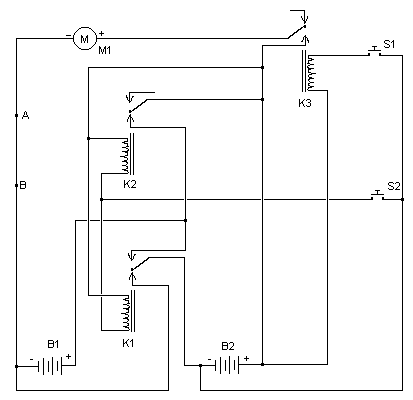
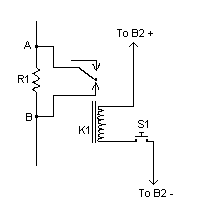
| My daughter had a 'new' but defective scooter given to her. The motor and batteries were fine, but the controller was shot. So I tried to make a simple go/no go controller for it. I had a LOT of relays salvaged from appliances, so getting enough of them was no problem. However, we soon learned that, while it DID work, sooner or later, usually sooner, the relay(s) would short closed. Even paralleling them, usually one or another would short closed, and we were right back to square one. This made the scooter want to run on despite the brake. (I kept that for obvious reasons, but it's rather wimpy) I knew that the relays I were using were rated for AC volts and amps, which I figured would be OK for DC as well, and, like you, I used one battery to run the relays, knowing that the drain was minimal. What I could not determine, at first, was the DC ratings for AC rated relays. I later learned that going from about 120 VAC to 12 VDC equaled about the same AMP rating as printed on the relay. Turns out this isn't enough, hence the fried relays, with stuck contacts. (Most of the relays I had on hand were in the range of 10 to 20 amps at best) The motor is already the right type, and the batteries were the ones that came with it, 12 V @ 7 AH or maybe it was 9 AH, I forget now. What I wanted to do, besides have BOTH 12 volt slow and 24 volt high speed, (I was having to change it manually) was to use regenerative braking, as the brakes on the thing were, as I said, wimpy at best, and we have hills which could be coasted down, extending the range. However, I am not an engineer, nor much of an electronics expert. This part, regenerative braking, was beyond me. I could not, and still do not, know of any simple way to accomplish this. I do know that the motor will act as a DC generator if turned, but how do I 'steer' the current the way I want, while NOT having the batteries trying to turn the motor themselves? This is the part that stumps me. I thought that, if the relays are closed, and the motor was turning fast enough to make MORE volts than the batteries were then at, it would automatically send the voltage the direction I wanted. Everything I have learned tells me that this should be so... Higher voltage to lower voltage, like hot to cold. (Higher energy to lower energy, in any form) Am I missing something simple here?
I also plan to include a 'fail safe' in case of stuck relays in the future. We have had some close calls with a kid on a run-away scooter. I would like to use something that absolutely can not fail to disconnect the battery(s) from the motor in a hurry should that ever happen again. I plan to rebuild the relays and all using the plans you provided, using proper rated automotive relays this time, even though I still have dozens and dozens of appliance relays on hand. Any ideas on a truly fail safe way? I'm thinking of a gadget like they use on treadmills, so if you fall off, you pull out a tab that stops it, but it can't be a relay type like treadmills use. Maybe a heavy duty wire disconnect of some sort?
Two copper contacts with a copper 'tab' that slides in between, making the motor wire whole, which would be attached to kid via string, and clipped to shirt. Pull out copper 'tab' and wire is 'broken' I can make that, although I know it will cause some loss and heating, I prefer that to a hurt kid.
Any and all suggestions will be greatly appreciated, as are your two speed controller. And may I offer this: Treadmills have a tremendous motor in them! I have found them to be PM DC motors, and easily made into generators, (Exercise bike and gas engine driven) step-less speed controlled lathe motors, and more. The electronics in them for speed control is easily adapted. If only it was all designed for 12/24 volts I'd be all set. But it's designed for 120 VAC, and this is converted to 90 VDC and on down, using a pot. Using the motor without the control electronics, as a generator, I have found that, with a good quality (gym type) exercise bike, I can easily make 12/14 volts at 10 amps and more, and with a small gas engine, I could make about 100 volts DC, (That engine wasn't running too good at the time, and gearing wasn't perfect) at amperage of I don't know! I don't know because I couldn't load it down enough to make a good guess. A 100 watt incandescent light bulb plugged in made the engine slow down not at all. I had expected it to stall the little snowblower engine, which, as I say, wasn't running up to snuff, but it (the load) made NO difference at all. I suspect I could have plugged in about 500 watts of resistive load before it would have bogged down the poorly running engine. (A two stroke of aprox. 5 HP if running right) my calculations tell me that 5 HP ought to be able to make a whole lot more that that, but I don;t think the DC motor could. It is rated at 90 Volts DC at something like 10 amps? I do not remember right off the top of my head now. Might have been more. Anyways, I can see several possibilities with such motors. With the exercise bike, using a dryer drum belt on the bikes own wheel, (making the wheel not only a flywheel, as it was intended, but a pulley too) and a small pulley on the DC motor, I was easily able to light up a car sealed beam headlight, although I can't keep up that pace for very long. (I have a progressive form of MS. = Multiple Sclerosis) I calculated that when I had the car headlamp going good, I was only making about 55 watts. (I had meters inline for amps and voltage too) Now, If I could only find a way to use several of these treadmill motors together with a single 6.5 HP 4 cycle, OHV engine, which I happen to have on hand, so that I can make the most of the horsepower of that engine even at just a fast idle, I should be able to make some real back-up power. I should be able to recharge our backup batteries, all at once, and in that way, survive the next big storm. (I'm in the Midwest, Tornado alley) It happens that we end up without power for as much a a couple of weeks at a time, when it happens. I can't take that heat and humidity, it's real bad for people with MS. But with a couple or several deep cycle batteries, an old UPS as inverter, as well as a 'portable' inverter, and a efficient way to recharge, we would be able to make it OK next time. I nearly died last time it happened.
I think I read that you work in the UPS business? What is your take on using them as inverters this way? I know I can't get more than about 700 watts out of mine, but I believe it's a much 'cleaner' sine wave form than the other inverter, which claims a "Modified Sine waveform" aka, a stepped square wave. I find that induction motors are picky about that. (Like fans, refrigerators, etc) Am I right, that a good, name brand UPS, which has 'cold start up' is the better for the job? (mine is an APC 700 'Smart UPS 700' which is good for about 700 watts, right?) We have used this setup for short outages, and it works, but we've never had to rely on it for more than a few hours so far. Using the car, or worse, my truck, to recharge batteries in an extended power outage is wasteful in the extreme. And you can't go get more gas... The gas station needs juice to run the pumps! (Plus the kids are too dumb to figure out how to make change without the cash register to tell them) I'd really like to have a decent system on hand, with out breaking my piggy bank. (Being 100% disabled, I'm on Social INsecurity, which doesn't pay real well, especially raising three daughters!) That's one reason I like to build and recycle as much (many) of the things I need as possible. (I also happen to just like tinkering around to stay busy, and doing for myself)
Your thoughts? Comments? Was this way too long? (I know, Yes it was. I used to be a freelance reporter, paid by the column inch, so, knowing I'd be heavily edited, I just wrote more, and more! A habit I still can't break)
Sincerely:
Chris Mills aka The Junkman
|