| melson |
tell the name of 2nd ic |
Saturday, July 09, 2016 4:38:07 AM |
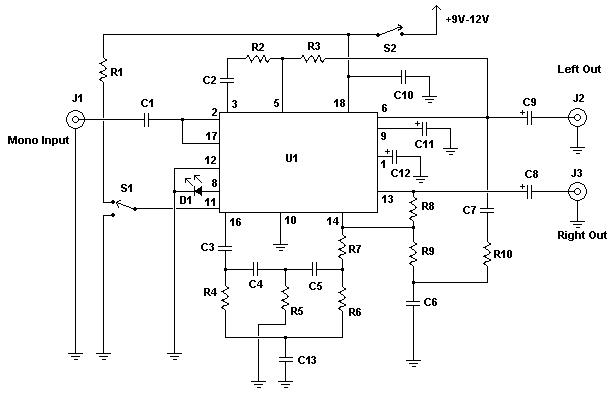
| i'm in india i have found some fm redio with two ic one is Hwcat cxa1619bs the second one is.. i dont that ic name upone that ic it has written 3810 BEL 9BC can u pls tell that name of that ic pls |
| anonymous |
Mono To Stereo Synthesizer |
Sunday, November 30, 2014 8:56:52 AM |
| If the editor took the time to leave a smart comment, why not update the parts list at the same time? (Editor's notes: What's up with the parts list?) |
| anonymous |
Mono To Stereo Synthesizer |
Wednesday, April 27, 2011 3:16:08 PM |
| ...and it's still not been changed.
Typical of a couldn't care attitude which is increasing on WEB! (Editor's notes: Because you know, operating the largest independent electronics site on the Internet is not time consuming at all, and a tiny error like this is just so high on the priority list because there's absolutely nothing else needed on the site at all at the moment.) |
| gccradioscience |
Mono To Stereo Synthesizer > Where is the IC? |
Tuesday, November 23, 2010 2:15:39 PM |
| I am having trouble finding this IC (TBA3810) to build this circuit. I need your help if you help me find sources on how to get this IC. This IC sounds very rare and discontinued. I will be using this circuit for low power part 15 broadcast on FM to take music that is mono and turn it into stereo, and also use it for my WiFI radio, connect it to an low powered stereo headphone amplifer to hear talk shows in stereo. (Editor's notes: There is a mistake in the parts list. The part number should be TDA not TBA. Will fix this soon...) |
| anonymous |
Mono To Stereo Synthesizer |
Sunday, February 08, 2009 4:26:32 PM |
| hi, I can replace the tda3810? I live in Portugal and I can get this ic... |
| anonymous |
what is the TBA3810 (442-794) |
Thursday, October 23, 2008 6:33:18 PM |
| SHURE, THERE'S MISTAKE IN PARTS LIST: TDA3810 datasheet |
| v.vinoth |
Mono To Stereo Synthesizer |
Friday, February 08, 2008 6:14:09 AM |
| *what is a value of C13? |
| anonymous |
Mono To Stereo Synthesizer |
Tuesday, January 22, 2008 4:44:56 AM |
| C13 = 0.033uF Ceramic Disc Capacitor |
| dinesh |
Mono To Stereo Synthesizer |
Monday, December 03, 2007 9:59:59 AM |
| what is the value of c13 |
| david paolo |
Mono To Stereo Synthesizer |
Wednesday, November 28, 2007 4:53:43 AM |
| any substitute for the tba3810 ic? |