| Alan |
Sound Level Meter |
Sunday, October 12, 2014 4:58:58 AM |
| I want to make a sound level circuit for detecting noise source under a car bonnet (or wherever it might be). Can I use electret microphones with a switched input from mic to mic and thus see which is nearest the noise source? |
| anonymous |
Sound Level Meter |
Sunday, February 24, 2013 3:33:30 PM |
| I am having the problem "of about 0.6V to pin 5". Regarding "The solution is quite simple though.", please share.
I am using a microphone into an LM386. Without the Peak Detector it works as expected.
If at all possible I would like to stick the the LM386. The only purpose for my circuit is to make the bar graph respond when someone speaks into the mic. I am not using the sound in any way (not even playing it into a speaker). Thanks! |
| peter west |
Sound Level Meter |
Monday, July 09, 2012 3:30:55 AM |
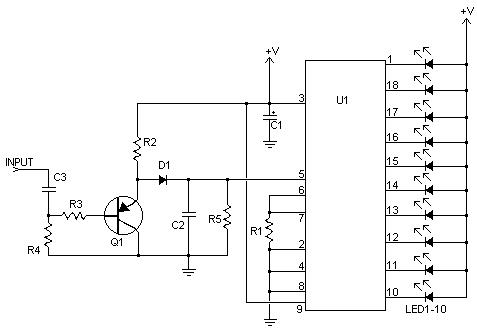
| I agree that the peak circuit is shown in the data sheet. I also agree it does not work. There is a good reason why not - the Vbe for the transistor is about 680mv, while the voltage drop across the diode is only 120mv [because there isn't any current with no input] The resulting 500mv+ turns all the leds on, as a number of people has remarked. The solution is quite simple though. |
| anonymous |
Sound Level Meter |
Friday, July 06, 2012 3:20:18 PM |
| This circuit WILL NOT WORK for line level signals; there will be a constant voltage of about 0.6V to pin 5, which will keep the lowest LEDs on constantly. Don't bother building this - use an opamp detector instead. |
| Pio |
Sound Level Meter |
Tuesday, April 03, 2012 8:16:44 AM |
| could any1 help me make a sound level meter that goes up to eleven? 11 LEDs that is. can this b altered to do so? also is it possible to add a Pezio elctric microphone to this circuit diagram?? |
| anonymous |
Sound Level Meter |
Thursday, December 01, 2011 2:46:05 PM |
| Does it matter if you use Carbon or Metal film resistors? (Editor's notes: Nope.) |
| Dimitris |
Sound Level Meter |
Sunday, August 08, 2010 8:46:35 AM |
| I think that u connect 5 with 3. There is no connection between them. 9 is directly connected to 3. (" All LED switches on when power is connected") |
| anonymous |
Sound Level Meter |
Thursday, June 03, 2010 10:48:17 AM |
| Built this circuit but it does not work properly.
All LED switches on when power is connected.
Any workaround for this problem?
|
| Eric |
Sound Level Meter |
Sunday, April 11, 2010 9:12:47 PM |
| I built this exact circuit using a 15V power supply and my LM3915 is overheating very badly. I am using a 1N4148 instead of the 1N914 but otherwise it is all the same. Does anyone have any ideas as to why this is happening? Also, before it gets too hot all the LEDs are lit when no audio signal is present. This would seem to indicate incorrect wiring but both I and another individual have checked it thoroughly.
A photo of circuit with all wiring can be provided if needed. |
| jcs |
Sound Level Meter |
Wednesday, January 27, 2010 12:16:39 PM |
| Just received some RGB LED's from someone made by this company:
http://www.lumiron.com/SPECTRO%20300RGB%20-%20T.html
I would like to try to drive them with this Sound Level Meter circuit.
The supply voltage for the LED's is 12 volts, so it should work fine.
Any ideas or suggestions would be much appreciated.
I figure 16.7 million colors is enough color to experiment with!!!
LOL!!! |