Transistor Organ


Author Views Views Today Rank Comments
28,006 7 14
This simple circuit can provide hours of enjoyment as you learn tunes, play duets or just make some really weird sounds by pushing all the buttons at once. You have probably seen this ciruit before, it is fairly common. I have seen it in several books. The best thing about the circuit is that you can tune each individual note, or go to a whole new octive by changing one capacitor (C1). Because of this, it is possible to from an entire Transistor Organ ensemble. Why you would want to do this is anyone's guess...

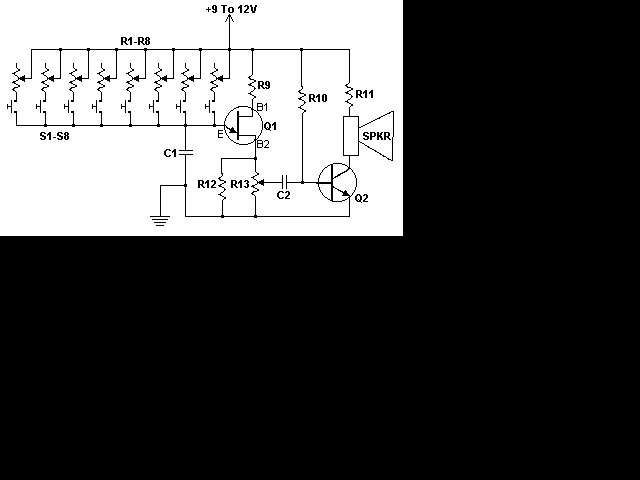
Schematic

This is the schematic of the Transistor Organ

Parts

Part
Total Qty.
Description
Substitutions
R1-R88250K Trim Or Regular Pot
R9, R122100 Ohm 1/4 W Resistor
R10110K 1/4 W Resistor
R111220 Ohm 1/4 W Resistor
R1315K Pot
C110.01uF Capacitor
C210.1uF Capacitor
Q112N4891 Unijunction Transistor
Q212N2222 Transistor2N3904
S1-S88SPST Switch
SPKR18 Ohm 2 W Speaker
MISC1Wire, Circuit Board, Knobs For Pots

Notes

  1. You can tune the organ to any instrument by adjusting R1-R8. I used a clarinet to tune mine, but you can of course use any instrument you wish.
  2. The circuit may drain a 9V battery fairly quickly at full volume. You may remove R11 for even more sound.
  3. You can rig up a relay and a foot switch to change C1 (for a different octive) while your playing.

Related Circuits

3 Watt FM Transmitter, 8 Watt Audio Amp, 22 Watt Audio Amplifier, 50 Watt Amplifier, Crystal Radio, FM Transmitter, Guitar Fuzz Effect, FET Audio Mixer, Microphone Mixer, 8 Note Tune Player, Op Amp Radio, Mono To Stereo Synthesizer, Electronic Stethoscope, Tone Control, Transistor Organ, Stereo Tube Amplifier, Digital Volume Control, Sound Level Meter, Aircraft Radio Communications Receiver

Comments

kadry
Transistor Organ
Sunday, March 09, 2008 12:57:16 PM
hi there, i am doing a project on this circuit, and was wondering if you have a booklet or any amount of information on this circuit.for example the way it works and all the specifications and conclusions considering it.i would appreciate it greatly. thankyou
anonymous
Transistor Organ
Wednesday, February 27, 2008 11:53:25 PM
I'm having some difficulty troubleshooting this circuit and I'd appreciate any ideas. I used the NTE6409 alternative and 8 500k pots instead of 250k's. Also I used an audio-taper pot for R13. The rest of the circuit is as described. How sensitive are the pot parameters and the capacitor parameters in getting an audible oscillation? I'm also using #26 wire, which may be on the thin side. Any responses in the comment section would be great!
Harry Layne BSc.
Transistor Organ
Tuesday, January 08, 2008 3:08:27 PM
Many years ago I built a very similar circuit 61 times, and formed a five octave organ. I was still doing my apprenticship in those days and could not afford a commercially built one. If one builds just a dozen or so of these circuits [of course you do not need all the presets, just one per unit], it is possible, as I have done many times, to set them up as a door bell, and have your favourite chord playing, instead of just a basic bell. When my friends heard mine they all wanted one so I was kept busy, and a few of my friends still have them working today, after all this time!.
anonymous
Transistor Organ
Saturday, January 05, 2008 6:07:11 PM
Here is a easy 555 version. http://josepino.com/circuits/index.php?555_circuits2.jpc
anonymous
Transistor Organ
Saturday, January 05, 2008 6:03:22 PM
Pretty much any older unijunction transistor (UJT) should work fine in this circuit. The NTE6401 and NTE6409 will work. 2N2646, 2N491, 2N489 are other part numbers that should work fine. The 2N6027 is a Programmable Unijunction Transistor (PUT) which is more like a thyristor and will NOT work without modifying the circuit. Radio Shack/Archer sold these for many years in generic three packs and singles of UJT's with no part number at all. Look on Ebay - should be pretty easy to find one. Was pretty common back in early days of transistors to make simple oscillator circuits with UJT's. You could also modify the circuit to use an IC Oscillator in place of the UJT such as the venerable 555. Search for 555 organ or 555 audio oscillator as I am sure there is a circuit out there on the web. One thing about this method is the UJT with only one additional transistor as amp will provide enough output power to drive a speaker directly.
Marc
Transistor Organ
Friday, November 09, 2007 2:04:49 PM
I would imagine it would be easy to add enough notes to get a full chromatic scale - just use 4 more trim pots the Capacitor with the momentary (or regular switch) is a really cool idea. Awesome schematic! although....what should the capacitor change be?
anonymous
Transistor Organ
Tuesday, October 30, 2007 12:53:46 AM
Has anyone tried the NTE cross (NTE6409) instead of the 2N4891?
anonymous
Transistor Organ
Monday, October 01, 2007 10:53:40 PM
i couldn't find 2N4891.Are there any alternatives
jokey
Transistor Organ
Friday, August 03, 2007 11:56:35 PM
Hi Please tell me which one is the R13 pot Trim or Regular? & if the specified UJT not available is there any more Substituion? Any Ujt can work or not?!! Please reply me... Thank You For The Circuit & Details..xx
anonymous
Transistor Organ
Thursday, July 26, 2007 8:28:20 PM
Is it possible to put more than the 8 shown resistor points for a wider range of sound?
The last 10 comments are currently shown. Show All Comments.

If you would like to leave a comment, you can do so using the form below. Comments can be things like suggestions, successes or failures, improvements, similar circuits, error reports, an answer to a previous commenter's question, or anything in between. However if you would like to ask a question it is suggested that you use the forum instead. The forum provides a more robust environment for discussion.

Important: If you post a technical question here, there is no guarantee it will be answered. All technical questions should be posted to the forum. The owner of this site generally does not answer questions in comments.

All comments are subject to approval before they are displayed here, so your comment will not appear immediately. This is done mainly to prevent spam and other abuse. If you wish to remain anonymous, simply enter "anonymous" for your name and/or email.

Name:
Email:
Subject:
Comments:
Anti Spam Code:
Please enter the exact text shown in the image above into the box below.
Browser cookies must be enabled to comment on circuits.

Privacy Policy

Back To Circuits Page | Mail Me | Search