| RAY pitts |
Automatic 12V Lead Acid Battery Charger |
Monday, May 25, 2020 6:50:22 AM |
| TO SAVE UN PLUGGING TO STOP BATTERY DRAIN, PLACE SUITABLE DIODE IN FEED TO BATTERY |
| Tharanga |
Automatic 12V Lead Acid Battery Charger |
Tuesday, September 18, 2018 11:47:03 AM |
|
Posted - Sep 18 2018 : 11:36:55 AM Show Profile Reply with Quote
I have made two 12V chargers using your circuit & both perfectly working.
Thank you for the circuit diagram.
Now I want to make a 24V charger. What are the values of components ? |
| Valeriy |
Automatic 12V Lead Acid Battery Charger |
Saturday, April 23, 2016 11:17:28 AM |
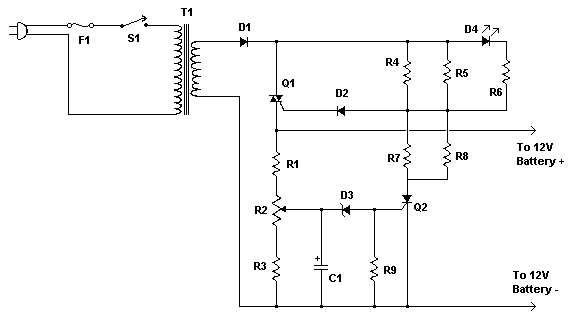
| Thanks a lot for the electrical circuit. I have done it, but I had to replace a 2 pair of resistors at 82 Ohm 2W (parallel pair gives 41 Ohm 4 Watt) instead five ceramic type resistors in series at 8.2 Ohm 10 Watt. In this case, no fan is needed. Slightly warm.
BRX49 could be replaced by mcr100-8 or P0102DA may be BT169 or 2N6565. See datasheet, compare. Ilike it. Very. |
| Muhammad ali arif |
Automatic 12V Lead Acid Battery Charger |
Thursday, December 03, 2015 12:10:00 AM |
| I want to build this circuit urgently for my 12Volts 7 AH /18AH /35Ah Dry Cell batteries .i am a newbie ,sorry for my bad english.
My Parts Specifications :
12V transformer 20 AMPS
35 AMPS BRIDGE KBPC3510 .
TRIAC BT137 8AMPS
SCR TNY616 16AMPS mounted on heat sink
Can i use full wave rectification for this circuit ?? and what is the output power of this circuit according to my specifications. ??
can triac is triggered through the output of bridge rectifier ??
|
| tuan |
Automatic 12V Lead Acid Battery Charger |
Friday, November 20, 2015 10:50:29 AM |
| If I want to design this circuit for charging the battery 6v What must be corrected. Using solar power is 12v identity. Please help me complete this project. (Editor's notes: Won't work from DC.) |
| anonymous |
Automatic 12V Lead Acid Battery Charger |
Sunday, July 12, 2015 7:44:07 AM |
| the half wave rectifier will not give the required 13.8v charging voltage if it is feed by the 12v ac from T1.
|
| Giovanni |
Automatic 12V Lead Acid Battery Charger |
Wednesday, April 15, 2015 8:35:59 PM |
| I built this circuit more than 20 years ago and I used two SCR and a bridge graetz.
I can guarantee that near zero volts the Q1 was dying anyway and left again at the next half-wave, of course, if the circuit demanded it.
Sometimes I used a Tr NPN instead of Q2, but I never used Zener diodes, resistors only calculated appropriately.
A defect and a merit of the circuit: while the charge current is reduced, the components are heated and increases their conduction thereby reducing the V Gate (or VBE). |
| KRYOS |
Automatic 12V Lead Acid Battery Charger |
Thursday, February 19, 2015 5:29:06 PM |
| hello I would like to ma information about the R2 component ... need to know if it is 100 Ohms or 100k Ohms eh ??
do not think this variable resistance of 100 Ohms here in Brazil
I can use a 100k in place of that of 100 Ohms or some other |
| azim |
Automatic 12V Lead Acid Battery Charger |
Wednesday, January 28, 2015 8:11:56 AM |
| HI
can this charger modified to give the battery charging level (more than one green led and one red during charging process).the charger can use the solar modules .If yes pls send me the circuit diagram and component list.Also the price of this kit.
thanks |
| anonymous |
Automatic 12V Lead Acid Battery Charger |
Sunday, November 23, 2014 7:55:00 AM |
| Thank you for the great Circuit. LED goes off at about every 10 seconds. Is it the normal state of operation or do I need to adjust Pot to glow it continuously. ? |