12V to 120V Inverter


Author Views Views Today Rank Comments
329,269 58 563

Have you ever wanted to run a TV, stereo or other appliance while on the road or camping? Well, this inverter should solve that problem. It takes 12 VDC and steps it up to 120 VAC. The wattage depends on which tansistors you use for Q1 and Q2, as well as how "big" a transformer you use for T1. The inverter can be constructed to supply anywhere from 1 to 1000 (1 KW) watts.

Important: If you have any questions or problems with the circuit, see the forum topic linked to in the Notes section. It will answer all your questions and provide links to many other (and better) inverter circuits.

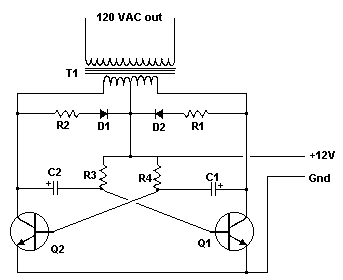
Schematic

This is a schematic of the Inverter

Parts

Part
Total Qty.
Description
Substitutions
C1, C2268 uf, 25 V Tantalum Capacitor
R1, R2210 Ohm, 5 Watt Resistor
R3, R42180 Ohm, 1 Watt Resistor
D1, D22HEP 154 Silicon Diode
Q1, Q222N3055 NPN Transistor (see "Notes")
T1124V, Center Tapped Transformer (see "Notes")
MISC1Wire, Case, Receptical (For Output)

Notes

  1. Q1 and Q2, as well as T1, determine how much wattage the inverter can supply. With Q1,Q2=2N3055 and T1= 15 A, the inverter can supply about 300 watts. Larger transformers and more powerful transistors can be substituted for T1, Q1 and Q2 for more power.
  2. The easiest and least expensive way to get a large T1 is to re-wind an old microwave transformer. These transformers are rated at about 1KW and are perfect. Go to a local TV repair shop and dig through the dumpster until you get the largest microwave you can find. The bigger the microwave the bigger transformer. Remove the transformer, being careful not to touch the large high voltage capacitor that might still be charged. If you want, you can test the transformer, but they are usually still good. Now, remove the old 2000 V secondary, being careful not to damage the primary. Leave the primary in tact. Now, wind on 12 turns of wire, twist a loop (center tap), and wind on 12 more turns. The guage of the wire will depend on how much current you plan to have the transformer supply. Enamel covered magnet wire works great for this. Now secure the windings with tape. Thats all there is to it. Remember to use high current transistors for Q1 and Q2. The 2N3055's in the parts list can only handle 15 amps each.
  3. Remember, when operating at high wattages, this circuit draws huge amounts of current. Don't let your battery go dead :-).
  4. Since this project produces 120 VAC, you must include a fuse and build the project in a case.
  5. You must use tantalum capacitors for C1 and C2. Regular electrolytics will overheat and explode. And yes, 68uF is the correct value. There are no substitutions.
  6. This circuit can be tricky to get going. Differences in transformers, transistors, parts substitutions or anything else not on this page may cause it to not function.
  7. If you want to make 220/240 VAC instead of 120 VAC, you need a transformer with a 220/240 primary (used as the secondary in this circuit as the transformer is backwards) instead of the 120V unit specified here. The rest of the circuit stays the same. But it takes twice the current at 12V to produce 240V as it does 120V.

  8. Check out this forum topic to answer many of the most commonly asked questions about this circuit: 12 - 120V Inverter Again. It covers the most common problems encountered and has some helpful suggestions.

Related Circuits

6V to 12V Converter, Portable CD Player Adapter For Car, Car Battery Charger, Automatic 12V Lead Acid Battery Charger, Solid State Tesla Coil/High Voltage Generator, 12VDC To 120VAC Inverter, LASER Power Supply, Power Supply, High Current Power Supply, Dual Polarity Power Supply, High Voltage High Current Power Supply, Transformerless Power Supply, Fixed Voltage Power Supply, Voltage Inverter, Voltage Inverter II, Automatic Load Sensing Power Switch

Comments

anonymous
12VDC To 120VAC Inverter
Tuesday, August 19, 2008 7:19:44 AM
I once bought an inverter on the internet. After a few days, it stopped working. I checked the output..behold, the Neutral and Live on the socket were both LIVE! what could possibly have gone wrong? Regards, Ax
Jared Palmer
12VDC To 120VAC Inverter
Wednesday, August 13, 2008 2:17:32 PM
If you guys want to test your own substitutions then I recommend you download NI Circuit Design Suite and Multisim. I put this circuit together with this program and set the parameters for the type of xformer and am get a fluctuating value of around 148 to around 158 v.
Kamal Hossan
12VDC To 120VAC Inverter
Thursday, July 31, 2008 8:28:30 AM
Dear sir, I m fail to arrange 68uf Tantulam capacitor, please let me know the susbtitute of this. Thanking you
anonymous
Exploding Tantalum caps
Wednesday, July 23, 2008 10:13:54 AM
You MUST get the POLARITY CORRECT or they will blow up!
khairi
12VDC To 120VAC Inverter
Wednesday, July 16, 2008 8:24:12 AM
hi.. can you give a clearer name for "HEP 154 Silicon Diode" so i could buy it.. i just told the store that name his answer was there no diode like that.. i hope that you give me a clearer name soon.....for instance 1n4005
Castleking88
12VDC To 120VAC Inverter
Sunday, June 29, 2008 7:39:05 PM
couldnt you substitute the capacitors for variable capacitors to achieve pulse width modulation?
anonymous
12VDC To 120VAC Inverter
Tuesday, June 24, 2008 10:26:55 AM
how can u calculate amps per turn in a transformer. secondly,the calculation of amps to watts
sedhu
12VDC To 120VAC Inverter
Friday, June 20, 2008 10:20:40 PM
I constructed a 12Vdc to 220Vac inverter,i inverted the dc 12V to ac 12V but my problem is when i connect a transformer i got only a 75V ac.. could you please help me to solve this problem?
okosi
12VDC To 120VAC Inverter
Monday, June 16, 2008 8:38:18 AM
what type of capacitor should i use to replcace the tantalum capacitor, since i cannot find exactly 68uf 25v in the market.
puche
12VDC To 120VAC Inverter
Wednesday, June 11, 2008 6:33:30 AM
Can i substitute 68 microfarad 25volts with 0.22jouls 68?
The last 10 comments are currently shown. Show All Comments.

If you would like to leave a comment, you can do so using the form below. Comments can be things like suggestions, successes or failures, improvements, similar circuits, error reports, an answer to a previous commenter's question, or anything in between. However if you would like to ask a question it is suggested that you use the forum instead. The forum provides a more robust environment for discussion.

Important: If you post a technical question here, there is no guarantee it will be answered. All technical questions should be posted to the forum. The owner of this site generally does not answer questions in comments.

All comments are subject to approval before they are displayed here, so your comment will not appear immediately. This is done mainly to prevent spam and other abuse. If you wish to remain anonymous, simply enter "anonymous" for your name and/or email.

Name:
Email:
Subject:
Comments:
Anti Spam Code:
Please enter the exact text shown in the image above into the box below.
Browser cookies must be enabled to comment on circuits.

Privacy Policy

Back To Circuits Page | Mail Me | Search