| Paul Patrakka |
High Current Power Supply |
Sunday, September 27, 2020 9:38:43 PM |
| For high current supply you can use microwave transformer ( secondary coil removed and recoiled for desired voltage ) with heavy wire and rectifier . For 14v power supply coil 10 turns of heavy wire , add high current rectifier and car audio capacitor like 1 Farad ... |
| ARXAIOS |
High Current Power Supply |
Monday, May 15, 2017 4:24:24 AM |
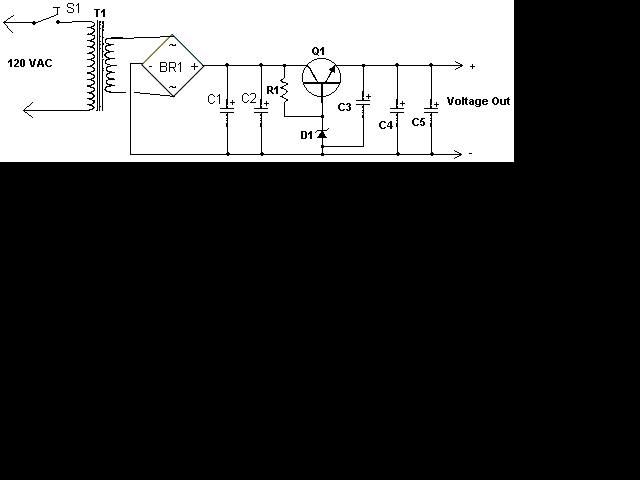
| First of all ..!! I made one like this and my opinion is this : do not build this one if you do not want to spend money on changing the power transistor because it will burn any time you draw sufficient current ..!
Very bad circuit and with no protection ... The ripple is at the roof at high current . The transistor will be dead no matter what heatsink you out on it. Also this circuit is very very bad if your load are dc motors .!
Instead of this OLD model of circuit you can use the safest way of putting a Voltage regulator with a power transistor on top of it with the current you want...
Good Luck. |
| Billy |
High Current Power Supply |
Thursday, October 31, 2013 12:35:26 PM |
| I have bought up most of the components to build my power supple. Was wondering if you could tell me how to build my Bridge Rectifier and how to add a variable to my 70A 17V power supply. I have the transformer and caps. I think I need a 100A 100V Bridge Rectifier but finding one like that has proved to be very hard! Please if you can tell me anything about how to build what I need or let me know what mite work I would be very greatful! Also any info that may help like a scumadic etc would help a lot. Thanks Bill |
| anonymous JEFF |
High Current Power Supply |
Thursday, August 01, 2013 8:08:50 PM |
| I need a power supply schematic to build a 13.8vdc 20amp power supply. I was wonder if this one on this page would work for that or would I need to change compoint sizes.
Thanks Jeff |
| jeans |
High Current Power Supply |
Tuesday, July 17, 2012 10:23:36 AM |
| Hello, I wonder how to get high current with this configuration?
Lets take the highest hfe for this transistor, 70.
With 12Dc and a resistor of 680Ohm result a current from 17mA x hfe 70 = 1,235 Amps??
|
| anonymous |
High Current Power Supply |
Wednesday, December 14, 2011 5:56:55 PM |
| he requests for specific "I need to do this" stuff leads me to this conclusion: Put the soldering iron down and step away and nobody gets hurt |
| anonymous |
High Current Power Supply |
Saturday, September 24, 2011 10:51:29 AM |
| i want to make a 12 volt 40 ampere power supply for a very urgent project. please send me any info regarding that
|
| John B |
High Current Power Supply |
Monday, March 22, 2010 12:06:28 AM |
| I have components for electrifying my bike. Is it feasable to use this PS, substitute a 12v 15A motor for the transformer and get my power for the motor and battery buffer? What other suggestions do you have? |
| peterlonz |
High Current Power Supply |
Friday, September 04, 2009 12:30:00 AM |
| Looks like a low cost easily built cicuit BUt it's design concept is for a fixed output.
I would very much like to see a variable 5A (or greater) in the range say 2 to 48V .
I am unable to "modify" your circuit to achieve this with a pot which anyway would involve switching to different resistance sub circuits - I thnk!!
The best type of variable is the infinitely variable which requires generally a digital voltmeter to be incorporated & this adds COST unless you have a low cost design for a digi-voltmeter??? |
| anonymous |
High Current Power Supply |
Friday, August 21, 2009 3:26:03 AM |
| Thank you for your circuit! |