| anonymous |
Power Supply |
Tuesday, January 20, 2015 5:43:46 AM |
| can i used 24 v 10 amp transformer with this circuit. |
| Hassam Balouch |
Power Supply |
Tuesday, November 12, 2013 11:37:31 AM |
| I have made this successfully but i did some changes by using LM350T volt Regulator and 10k pot . |
| GNM |
Power Supply |
Thursday, June 27, 2013 11:29:09 PM |
| Hello again. I commented on this LM338K-based power supply. back in 2008 when I built a dual version for my G-Scale Model Railroad. It's still working great with no problems! It's great circuit. It's very stable and easily puts out 5 amps at up to 30 volts. The amperage has been checked with a DC clamp meter and suitable dummy load.
Thanks again. I really like your website here, too.
Regards. |
| Jason Timbrook |
Power Supply |
Monday, February 27, 2012 1:12:09 AM |
| Hello, I've never wired up anything, but as a working tattoo artist, have run across the need to. What I am looking to build is a power supply with a 3 way toggle that could run 3 separate tattoo machines, one at a time. Preferably 0-18v @ 2a. Could someone please help me come up with a parts list and wiring diagram for something like this? It would be much appreciated. Thanks in advance! |
| smit |
Power Supply |
Monday, August 01, 2011 8:48:32 AM |
| I want to build a power suplly inwhich 220voltage (vac) is used and variable voltage 0-----30 volts will outper(DC) and the minimum output current is 1 amp Please help me to bulid this circuit diagram I WILL BE VERY THANKFUL TO YOU. |
| Daniel |
Power Supply |
Tuesday, March 01, 2011 8:55:09 AM |
| I have given up trying to locate a 24V 5A transformer. they do not exist. the one with the lowest amps I can find is a 10 amp. will that be ok? |
| anonymous |
Power Supply |
Friday, December 10, 2010 5:33:46 AM |
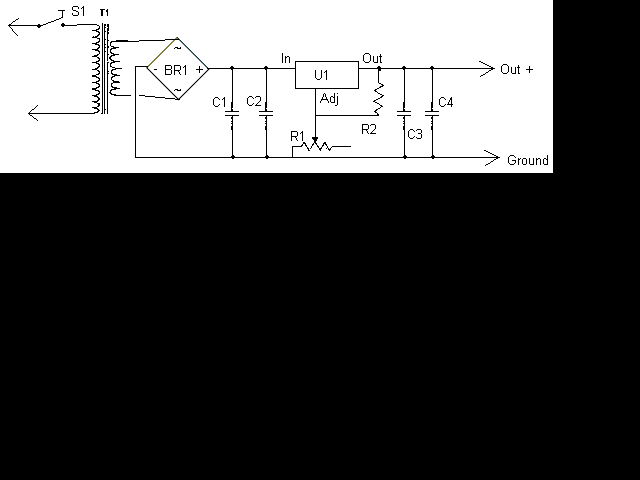
| R2 gets super hot, and the pot get in fire. These 2 resistors are connected from the positive to the negative rails, WHY? It burns the resistor across the rails.
I am sure this circuit diagram is right, as I saw it from many difference places, but why the pot burned? I am sure I have a right setup. |
| Adam Kellerson |
Power Supply |
Sunday, June 20, 2010 6:55:42 PM |
| More a curiosity question than anything. The LM338 schematic shows an input voltage of greater than 28V while you have a transformer outputting 24v spec'd out. (assuming 120Vac input)
? |
| Tom |
Power Supply |
Sunday, February 14, 2010 11:47:34 PM |
| I have a couple 13.8 vdc power supplies that were used for ham radio; I'd like to build an aux. project box to use as a 1.2 to 12 vdc, 5A Variable Power Supply. If I include everything to the right of the bridge rectifier in the above circuit, am I on the right track? ... Thank you very much for your reply! |
| Mike Tanner |
Power Supply |
Wednesday, January 20, 2010 6:12:41 AM |
| Hi Aarron
What pin on the 2n3005 is the IN, OUT and ADJ. The data sheet for the 2n3055 does not give this kind of info.
Am I to assume that the IN is the Collector, the OUT is the emitter, and the ADJ is the base.
I have tried to wire this up but it is not working. I may have burn something up or have it wired up wrong.
Thanks
Mike |