| Franklin Newhart |
High Voltage High Current Power Supply |
Friday, June 26, 2015 2:14:06 AM |
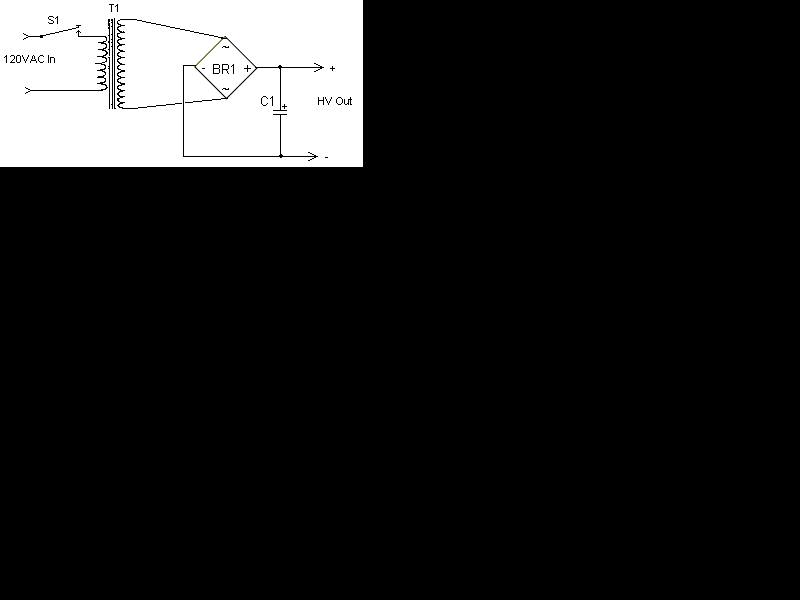
| For those of you wondering if this can be used for a Jacobs ladder. No it can't. Not quite enough voltage but the amps are ok. But you can make a Jacobs Ladder using two transformers. Join the two transformers together via the grounded wire. This makes the centre tap that you won't be using. You now have twice the voltage across the two free wires. Rectify that with great big diodes. You can collect them from the same microwaves that you got the transformers from. Use both the AC filter caps before rectification and attach the two wires to the Jacob's Ladder after rectification. And Don't Kill yourself because now you have 4400 volts at about a half an amp and it will kill you. Makes your hair stand up too. |
| David |
High Voltage High Current Power Supply |
Sunday, January 19, 2014 5:27:05 PM |
| This is utterly dangerous in the in-experienced hands!
A microwave transformer is not built like a 'normal transformer'. One end of the high voltage winding IS connected to it's metal core - I will repeat...!
One end of the high voltage winding on a microwave transformer is connected to the metal core.... and this is 2000V at some 500mA (0.5A) or so...!
For goodness should you need a high voltage supply do us a proper isolated one transformer!
FYI: A microwave cooker uses a upside down half wave rectification meaning; the positive side is grounded whilst the negative output goes to the magnetrons heater cathode.
DON'T MESS ABOUT WITH THESE FOR THE VERY REASON GIVEN.
The regulation for a power supply would be very poor because unlike a normal transformer that uses 'E' and 'I' lamentation's in an alternative arrangement a microwave transformer doesn't, you have the 'E' lamination as one stack and the 'I' lamination's at the end, creating an 'airgap' - thats why they buzz when running. |
| anonymous |
High Voltage High Current Power Supply |
Wednesday, April 04, 2012 10:51:23 PM |
| what would you think if people/kids got killed playing around with this? would your disclaimer make you feel any better? (Editor's notes: Chlorine for the gene pool.) |
| Jim |
High Voltage High Current Power Supply |
Thursday, November 10, 2011 10:30:10 PM |
| To TYKO You would need to get a transformer about the size of a pickup truck, some non-existent diode bridge and a power substation to supply the input. All connecting wires would need to be solid copper bus bars approximately 2" x 2". I think maybe you meant 5-8 amps and not 5000 to 8000 amps. If so, the microwave transformer is not sufficient but diode bridges do exist in this amperage. Number 6 wire would be sufficient for intermittent duty but no. 4 would be better especially if more than a few inches long. |
| DigitalAmigo69 |
High Voltage High Current Power Supply |
Thursday, August 25, 2011 3:04:27 PM |
| "Its good one. But iwas looking for a circuit 0 to 500VDC variable voltage and 0 to 1000MA variable current circuit. Can you help me in this circuit. Thankyou." (Robinson)
SEPIC or BOOST topology switching DC-DC converters might be interesting for you...
http://roboforum.ru/download/file.php?id=4576&mode=view
http://en.wikipedia.org/wiki/SEPIC
http://en.wikipedia.org/wiki/DC-to-DC_converter
http://www.nomad.ee/micros/mc34063a/
Trough, you still have to find or design a circuit, that meets your requirements... But I hope you cached some ideas, that might help :)
One more thing - some circuits need to add some elements in order to get 0..nn V.
With out negative grounds, you might have 1,2..nn V (depending on the IC's used...)
Another simple idea - use auto transformer with the same simple circuit - rectifliers+capacitor banks added (some LC filter also wouldn't hurt)
(^',^) |
| anonymous |
High Voltage High Current Power Supply |
Friday, April 22, 2011 10:28:51 PM |
| you can get a lot of power using a marx or cockcroft_walton
with the marx its best to use inductors or solenoids and avalanche or a gas discharge tube
the cw is good as is
but i have gotten better peak power by putting a cap form output to input |
| anonymous |
High Voltage High Current Power Supply |
Thursday, January 20, 2011 6:31:20 PM |
| I cannot find the transformer needed in the circuit anywhere I look. Could somebody help me? Please? |
| anonymous |
High Voltage High Current Power Supply |
Wednesday, December 23, 2009 12:22:11 PM |
| How can this circuit be modified so it can give high voltage, but low current, something like 400 ľA to 1mA, like that who are used at the electric fences so the animals don't escape? (Editor's notes: Don't.) |
| anonymous |
High Voltage High Current Power Supply |
Wednesday, December 23, 2009 8:17:19 AM |
| Can a resistor be placed at the plus output to regulate the current down to some microamps or nanoamps? |
| anonymous |
High Voltage High Current Power Supply |
Friday, December 11, 2009 1:32:18 AM |
| i am designing a 3 phase input 4kV/1A dc output power supply what should the rating of my diodes, capacitors and bleeder resistors be? |