| Panagiotis |
Transformerless Power Supply |
Thursday, July 14, 2016 1:21:14 PM |
| Thanks a lot my friend it works and very well. I just now must make it for 5V output :). |
| anonymous |
Transformerless Power Supply |
Tuesday, November 29, 2011 10:07:55 AM |
| could this circuit be possible in a photo switch streetlights? |
| XN |
Transformerless Power Supply |
Sunday, November 13, 2011 9:09:36 PM |
| is it possible to connect an LM317 after the bridge rectifier for the transformerless power supply...like this one on your page? |
| anonymous |
Transformerless Power Supply |
Sunday, November 13, 2011 9:18:22 AM |
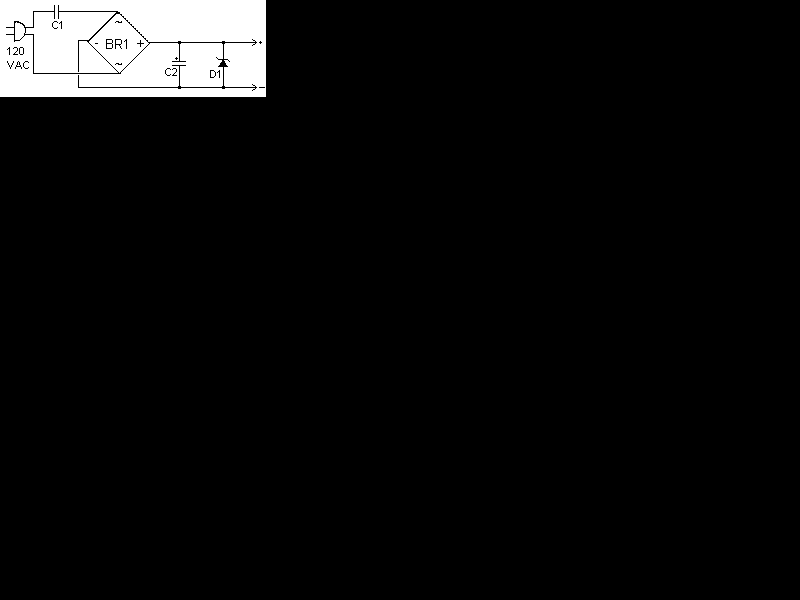
| 1. Please indicate polarity of C1. All 400v capacitors i find are rated + and - on the pins. C2 polarity is clear.
2. I am trying to convert from 220v ac to 30v dc supply, can i use 30V rated Zener diode and 45v rated C2 ????? |
| frq |
Transformerless Power Supply |
Tuesday, January 04, 2011 10:23:59 PM |
| I am searching for a transformerless power supply with high current rating. Output-12V,and high current rating |
| anonymous |
Transformerless Power Supply |
Wednesday, September 15, 2010 4:10:28 AM |
| hi. is it safe if 10th std make this circuit and show its working for a science woking model fair. |
| anonymous |
Transformerless Power Supply |
Sunday, September 05, 2010 3:09:13 AM |
| i, I would like to know what would happen if (line voltage : 220 - 240 v 50 Hz) : 1 what modifications would be neccessary to protect the circuit conditions. Thank you! |
| anonymous |
Transformerless Power Supply |
Thursday, April 22, 2010 3:00:36 PM |
| hi, could you pls tell me how much voltage does this curcuit supply ? thanks |
| Sundeep |
Transformerless Power Supply |
Sunday, February 07, 2010 6:35:47 AM |
| Hi,
I would like to know what would happen if (line voltage : 220 - 240 v 50 Hz) :
1 The voltage drops to 120v 50Hz.
2 The circuit is switched on at line voltage 300v 50 Hz.
what modifications would be neccessary to protect the circuit in both conditions.
Thank you!
|
| Ehet |
Transformerless Power Supply |
Friday, December 11, 2009 9:31:29 AM |
| Build this power supply in a case |